


To build an elite team, you need a goal big enough to generate its own gravitational pull.
When most leaders try to build a great team, they look backward. They scour resumes, obsess over track records, and dissect past experiences. The underlying assumption in corporate culture is simple: Who you were in the past dictates who you will be for me.
But this is a fundamental misunderstanding of human performance.
Great teams are not pushed by their pasts; they are pulled by their futures. The defining characteristic of an elite team isn’t a shared history of competence—it’s a shared commitment to a massive, seemingly impossible goal.
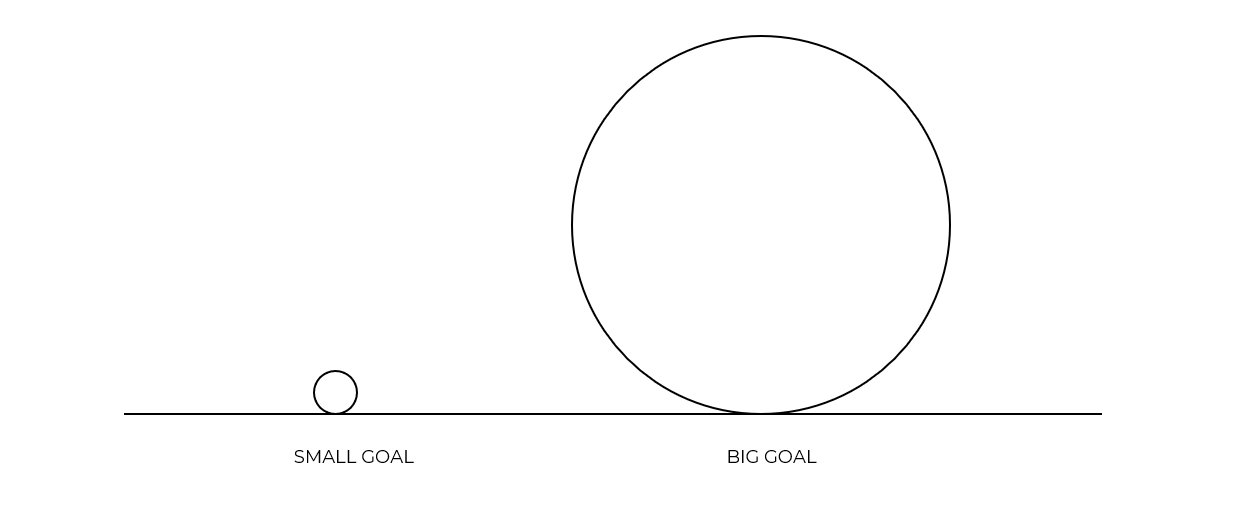
If your team is currently underperforming, paralyzed by office politics, or operating in silos, the problem rarely lies in their individual skills. The problem is that your goals are too small to demand greatness.
Here is the science, psychology, and strategy behind why the sheer size of your goal is the ultimate architect of your team.
The Physics of “Big Energy”
Most corporate goals are tragically boring. They are built on the religion of incrementalism: “Let’s increase efficiency by 5%.” “Let’s grow sales by 8% this quarter.”
In his recent appearance on the School of Greatness podcast, organizational expert Price Pritchett pointed out a fatal flaw in this thinking: Small goals drain our energy [1].
No one wakes up early for a 5% bump in Q3 metrics. Incremental goals feel like a chore. They invite complaining, foot-dragging, and bureaucratic resistance. When you ask a team to improve by 10%, they simply try to do what they are already doing, just a little bit harder and a little bit faster. This leads to burnout.
But when you set a massive goal—what Pritchett calls a “Quantum Leap”—it generates a visceral physiological response. Big goals attract big energy [1]. When a target is so large that it renders your old methods utterly obsolete, it jolts the team awake. You can’t work 1,000% harder, which means you are forced to think differently. The audacity of the goal creates a high-voltage environment that instantly burns away apathy.
The “Rafa” Effect: Rewriting the Present for the Future
To understand how a massive goal forces the evolution of a team and an individual, we only need to look at one of the greatest athletes in history: Rafael Nadal.
In the recent Netflix docuseries exploring his legacy, we see the raw reality of Nadal’s career [2]. Early on, he was the undisputed “King of Clay.” If Nadal had set an incremental goal—I want to win 10% more matches on clay—he would have just kept doing what he was doing. He would have stayed comfortable.
But Nadal and his team set a Quantum Leap goal: Win Wimbledon and dethrone Roger Federer on grass.
Grass is a fast, slippery surface that completely neutralized Nadal’s heavy topspin and baseline endurance. To achieve this impossible goal, Nadal’s past experience on clay was useless. His team had to engineer a completely new future. Nadal had to change his serve, flatten his groundstrokes, learn to volley, and alter his movement.
The massive goal demanded evolution. It generated the agonizing energy required to push his body to the breaking point. His team didn’t rely on his past greatness; they let the impossible future dictate what they had to learn in the present. In 2008, he defeated Federer in what is widely considered the greatest tennis match ever played. That is the gravity of the impossible.
The “Drive” Imperative: Mastery and Purpose
You cannot recruit top-tier talent with a mediocre vision. A-players are not looking for a comfortable place to park their skills; they are looking for a crusade.
In his landmark book Drive, behavioral science author Daniel Pink proved that once basic financial needs are met, the best performers are no longer motivated by money (extrinsic rewards). They are driven by three intrinsic forces: Autonomy, Mastery, and Purpose [3].
A massive goal taps directly into the highest levels of Pink’s framework:
Mastery: A 5% goal allows employees to coast on their current skills. A 10x goal demands that they evolve, just like Nadal. It forces the pursuit of Mastery, triggering the deep, intrinsic human desire to get better at something that matters [3].
Purpose: A massive goal gives the struggle a reason. If the goal is just “make the shareholders more money,” the team will give you the minimum viable effort. But if the goal is industry-shaking, you trigger profound purpose.
The Talent Magnet: The MTP
Author Salim Ismail takes Pink’s concept of purpose and scales it to the organizational level with the MTP—the Massive Transformative Purpose [4].
Think of SpaceX: “Make humanity multi-planetary.” Or Google’s early MTP: “Organize the world’s information.”
SpaceX doesn’t attract the most brilliant aerospace engineers in the world because they offer the most comfortable work-life balance. They attract elite talent because the goal is so massive it acts as a magnet. Big goals filter out the mercenaries who just want a paycheck and attract the missionaries who want to leave a dent in the universe. If your team is comprised of uninspired performers, your hiring process might be fine—your vision is just too small to attract anyone else.
Prospection: The Science of the Future Pull
Psychologist Dr. Benjamin Hardy and leading researchers on “Prospection” have demonstrated that humans are fundamentally teleological. This means we are the only creatures driven primarily by our anticipation of the future, rather than just reacting to our past [5].
When a team lacks a compelling, massive future, they default to their past. They argue over old processes. They defend their previous territories. They say, “We tried that before, and it didn’t work.”
But when you drop a massive, impossible goal into the center of the room, the future takes over.
The junior employee with massive ambition suddenly becomes more valuable than the 20-year veteran who is clinging to old paradigms.
Departmental silos shatter, because a massive goal physically cannot be achieved by one faction acting alone.
Egos are neutralized, because the mission is mathematically larger than any individual in the room.
The Leadership Takeaway
If your team feels sluggish, disconnected, or stuck in a rut, do not look for the solution in HR team-building exercises. Look at the horizon.
Audit your goals: Are you asking your team for a boring 10% improvement, or a radical Quantum Leap?
Demand Mastery: Does your goal require your team to learn entirely new skills to survive? If not, it’s too small.
Let the goal do the filtering: Set a target so big that it terrifies the comfort-seekers and magnetizes the visionaries.
You don’t build a great team to achieve big goals.
You set massive goals, and the greatness of the team is forged in the pursuit of them.
Sources & References
[1] Pritchett, P. (2024). Interview on The School of Greatness podcast with Lewis Howes. (Pritchett discusses concepts from his book You², highlighting how small goals drain human energy while massive, “quantum leap” goals generate the high energy required for radical transformation).
[2] Netflix. (Reflecting the overarching narrative from documentaries and sports analyses surrounding Rafael Nadal, specifically his conscious, agonizing evolution from a clay-court specialist to a Wimbledon champion to achieve the “impossible” goal of dethroning Roger Federer).
[3] Pink, D. H. (2009). Drive: The Surprising Truth About What Motivates Us. Riverhead Books. (Details the shift from extrinsic to intrinsic motivation, proving that high performers are driven by Autonomy, Mastery, and Purpose).
[4] Ismail, S., Malone, M. S., & van Geest, Y. (2014). Exponential Organizations: Why new organizations are ten times better, faster, and cheaper than yours (and what to do about it). Diversion Books. (Explains the necessity of a Massive Transformative Purpose (MTP) to attract elite talent and outpace competition).
[5] Seligman, M. E. P., Railton, P., Baumeister, R. F., & Sripada, C. (2013). “Navigating Into the Future or Driven by the Past.” Perspectives on Psychological Science, 8(2), 119-141. (Demonstrates that human behavior is shaped by “prospection”—pulled by our anticipation of the future—rather than strictly caused by past experiences).