


If you walk into almost any modern manufacturing plant, tech startup, or corporate office today, you will see the fingerprints of the Toyota Production System (TPS).
You’ll see Kanban boards. You’ll hear people talking about Kaizen events, Six Sigma, Andon cords, and the 5 Whys.
For the last forty years, the whole world has been trying to copy Toyota. And yet, almost everyone fails to replicate Toyota’s sustained, multi-generational success [2]. Why?
Because we fell into the Toolbox Trap.
Western businesses looked at Toyota and saw a collection of highly efficient tools. We copied the artifacts, the spreadsheets, and the flowcharts. But we completely missed the invisible architecture that actually makes the tools work: The Culture.
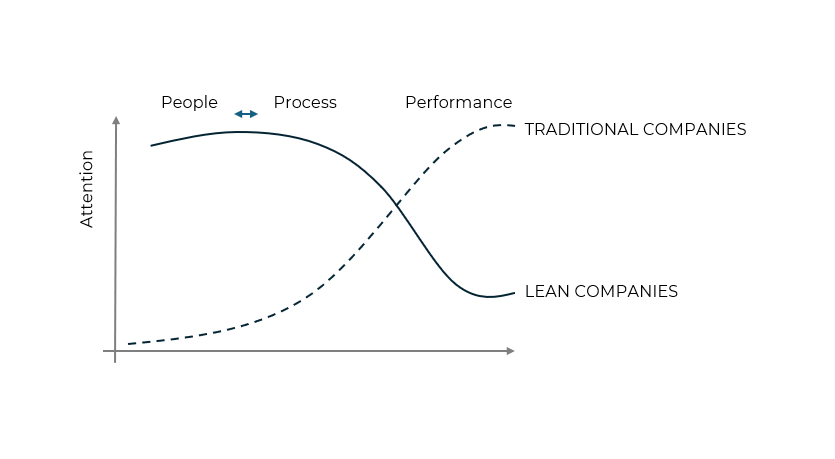
Here is the fundamental difference: Traditional companies manage results. Toyota manages people, processes, and the interactions between them [3].
To understand how they actually do this, we have to talk about the concept of Kata [1].
The Illusion of “Management by Results”
In a traditional company, leadership is heavily indexed on outcomes. We set KPIs, OKRs, and quarterly targets. If the numbers are green, the traditional manager is happy. If the numbers are red, the traditional manager demands a plan to fix them.
This is “Management by Spreadsheet.” It assumes that if you demand a certain result, the people below you will figure out how to get there. But this creates a culture of hiding problems, gaming the metrics, and taking dangerous shortcuts.
Toyota flipped this paradigm. They realized that results are just lagging indicators of your processes and your people [2]. If you deeply understand the work, build a robust process, and continuously develop the people doing the work, the results will inevitably follow.
But how do you teach an entire organization to think this way? You don’t do it with a mission statement. You do it through practice. You do it through Katas [1].
The Two Katas
In martial arts, a “kata” is a choreographed pattern of movements you practice over and over again until it becomes muscle memory. You don’t practice the kata to use those exact moves in a street fight; you practice the kata to rewire your brain and reflexes.
At Toyota, there are two fundamental Katas that drive their entire culture [1].
1. The Improvement Kata
This is the routine for solving problems and achieving goals. It’s a scientific way of thinking that prevents people from jumping to conclusions. It follows four steps:
Understand the Direction: What is the ultimate vision or challenge?
Grasp the Current Condition: Where are we exactly right now? (No guessing, go look).
Establish the Next Target Condition: What is the next immediate state we need to reach on the way to our goal?
Experiment (PDCA): Run small, rapid experiments (Plan-Do-Check-Act) to navigate the obstacles between where we are and the target condition.
Most companies that attempt “Lean” stop here. They try to teach their employees the Improvement Kata.
But the Improvement Kata cannot survive on its own. Without the second Kata, the entire system collapses.
2. The Coaching Kata (The Real Engine)
This is the hidden secret of Toyota. The Coaching Kata is the routine that coach-leaders use to teach the Improvement Kata to their teams [1].
At Toyota, a coach-leader’s primary job is not to hit a quota; their primary job is to develop the problem-solving capabilities of their people [3].
Instead of walking onto the floor and saying, “Why are we behind schedule? Fix it!” a Toyota coach-leader guides the employee through the scientific method. They use a highly specific, repetitive structure known as the 5 + 4 Coaching Kata Questions [4]:
1. What is the target condition?
2. What is the actual condition now?
(Here, the coach-leader pauses. If the employee has taken a step since the last coaching cycle, the coach-leader asks the 4 Supporting Reflection Questions before moving on):
What was your last step?
What did you expect?
What actually happened?
What did you learn?
(Once the learning is extracted, the core questions resume):
3. What obstacles are preventing you from reaching the target condition? Which one are you addressing now?
4. What is your next step (experiment)?
5. How quickly can we go and see what we have learned from taking that step?
Notice the brilliance of those four reflection questions. The coach-leader is not asking, “Why did you fail?” They are asking, “What did you expect, what actually happened, and what did we learn?”
The coach-leader is not giving the answer. The coach-leader is not focused on the end-of-quarter financial result. The coach-leader is focusing entirely on the interaction between the worker and the process. They are building a scientist.
The Takeaway: Stop Copying the Tools
When we only copy Toyota’s tools—like Kanban or value-stream mapping—we are just rearranging the furniture. Tools rust. Tools become obsolete. Tools are eventually abandoned when a new traditional manager comes in with a new flavor-of-the-month framework.
But when you practice the Katas, you build a culture.
If you want to build a truly resilient, world-class organization, stop staring at the scoreboard. Look at your people, look at your processes, and ask yourself: Am I acting as a dictator of results, or a coach-leader of capability?
References
[1] Rother, M. (2009). Toyota Kata: Managing People for Improvement, Adaptiveness and Superior Results. McGraw-Hill.
Note: This is the foundational text that formally decoded why Western Lean initiatives fail. Rother introduced the concepts of the Improvement Kata and the Coaching Kata to explain the invisible routines coach-leaders use to drive Toyota’s success.
[2] Liker, J. K. (2004). The Toyota Way: 14 Management Principles from the World’s Greatest Manufacturer. McGraw-Hill.
Note: The definitive overview of Toyota’s underlying philosophy. Liker extensively documents how Western management’s obsession with short-term results directly conflicts with Toyota’s focus on long-term philosophy, continuous process flow, and people development.
[3] Liker, J. K., & Hoseus, M. (2008). Toyota Culture: The Heart and Soul of the Toyota Way. McGraw-Hill.
Note: Co-authored by a former Toyota HR executive, this book proves that Toyota’s tools are useless without its human element. It details how the company hires, trains, and uses the coach-leader model to foster a culture of problem solvers.
[4] Rother, M. (2017). The Toyota Kata Practice Guide: Practicing Scientific Thinking Skills for Superior Results in 20 Minutes a Day. McGraw-Hill.
Note: The practical workbook companion to Toyota Kata. It provides the actual frameworks, the famous “5 Questions” pocket card (including the crucial 4 reflection questions on the back), and the exact cycles coach-leaders need to implement the Coaching Kata with their teams.