


For decades, business leaders have used the same tired cliché to describe synergy: “In a great team, 2+2=5.”
It’s meant to illustrate that a team is greater than the sum of its parts. But as a metaphor for modern teamwork, it is fundamentally flawed. Why? Because it assumes that teamwork is based on addition.
In the industrial age, work was additive. If you had three workers digging a trench, Worker A dug one meter, Worker B dug one meter, and Worker C dug one meter. Total output: 3 meters. If Worker C had a bad day and dug nothing, you still got 2 meters.
But as management legend Peter Drucker noted, we have shifted to a knowledge economy where work is highly interdependent [1]. You aren’t digging separate trenches; you are building complex systems together. In this environment, team strength is not a sum. It is a multiplication.
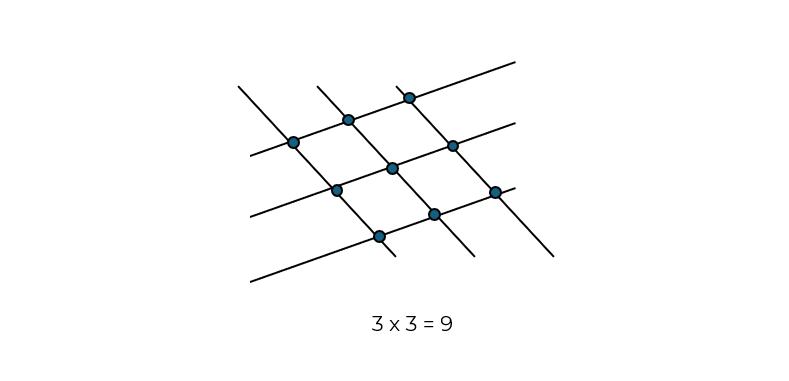
When you change the equation from addition to multiplication, the mathematics of team performance radically shift. Let’s look at the science and the math behind why great teams scale exponentially—and why bad teams collapse to zero.
The Equation of Exponential Teams:
T=M1×M2×M3...T=M1×M2×M3...Imagine we assign a “Collaboration Value” to employees based on their skills, communication, and ability to elevate others.
The “Average” Team
Let’s say a solid, reliable, average team member has a value of 2.
When two average people work together, they don’t just add their skills; they multiply them through basic collaboration.
Equation:
2×2=4This is your baseline. The team functions normally.
The “Outstanding” Team
Now, what happens when you bring together highly talented, deeply collaborative people? In her research on leadership, Liz Wiseman calls these individuals “Multipliers”—people who use their intelligence to amplify the smarts and capabilities of the people around them [2]. Let’s assign them a value of 3.
Equation:
3×3=9Look at the math. A team of Multipliers isn’t just slightly better than the average team; they are producing more than double the value:
9vs
4If you add a third outstanding member, it jumps to
3×3×3=27This exponential growth explains why elite teams (like early startup squads) can outmaneuver organizations ten times their size.
The Danger of Fractions: When the Math Turns Brutal
Here is where the multiplicative equation reveals a dark truth about team dynamics. What happens when a team member is toxic, disengaged, or a poor communicator? Their value drops below 1. Let’s assign a difficult employee a value of 0.9.
If work were additive, an underperformer would just add slightly less value to the total
1+0.9=1.9But because modern work is interdependent, they act as a bottleneck. They withhold critical information, or they destroy the team’s psychological safety.
Because the equation is multiplicative, putting two sub-par members together doesn’t yield a positive sum:
Equation:
0.9×0.9=0.81Suddenly, the team is producing less than a single capable person acting alone. This isn’t just theory. In a famous organizational behavior study, researcher Will Felps placed a single “bad apple” (an actor playing a slacker, a jerk, or a depressive) into various working groups. He found that just one negative person dropped the entire team’s performance by 30% to 40% [3]. The fraction pulled the whole equation down.
Even more terrifying is what happens when you pair an outstanding rockstar (3) with a toxic teammate (0.5).
Equation:
3×0.5=1.5The brilliant employee’s impact is instantly slashed in half. They spend all their energy managing the friction caused by the fraction.
What Determines the Number?
It’s vital to understand that a person’s “multiplier” is not just their raw IQ or technical skill.
You can have a brilliant engineer who is a total jerk. Because he refuses to document his work, belittles junior staff, and refuses to collaborate, his multiplier is 0.8. He is mathematically dragging the team down, despite his genius. Stanford professor Robert Sutton famously documented this in The No Asshole Rule, proving that the systemic damage caused by toxic high-performers vastly outweighs their individual contributions [4].
Conversely, a junior employee with average technical skills but a phenomenal attitude—who asks great questions, organizes workflows, and makes everyone around them feel safe to share ideas—might be a 2.5. They are a net multiplier.
The Leadership Takeaway
When building and managing teams, leaders need to stop thinking in terms of addition. You cannot simply add five random people to a project and expect the output to be “5”.
Hire for multipliers: Look for communication, empathy, and collaborative problem-solving.
Remove the fractions: A single toxic individual doesn’t just lower the team’s average—they mathematically divide the team’s total potential.
Nurture the equation: In Google’s massive study on team effectiveness (Project Aristotle), they found that the number one driver of team success wasn’t the combined IQ of the members, but psychological safety [5]. Trust is the operator that allows multiplication to happen. Without it, employees retreat into their silos, and the equation reverts to uninspired addition.
In the modern workplace, 2+2 doesn’t equal 5.
If you build the team wrong,
0.9×0.9=0.81
But if you build it right,
3×3=9is just the beginning.
Sources & References
[1] Drucker, P. F. (1999). Management Challenges for the 21st Century. HarperBusiness. (Drucker outlines the shift to knowledge work and the necessity of interdependent collaboration).
[2] Wiseman, L., & McKeown, G. (2010). Multipliers: How the Best Leaders Make Everyone Smarter. HarperBusiness. (Explores the concept of leaders and team members who amplify vs. diminish the intelligence of those around them).
[3] Felps, W., Mitchell, T. R., & Byington, E. (2006). “How, When, and Why Bad Apples Spoil the Barrel: Negative Group Members and Dysfunctional Groups.” Research in Organizational Behavior, 27, 175-222.
[4] Sutton, R. I. (2007). The No Asshole Rule: Building a Civilized Workplace and Surviving One That Isn’t. Business Plus.
[5] Duhigg, C. (2016). “What Google Learned From Its Quest to Build the Perfect Team.” The New York Times Magazine. (Details “Project Aristotle” and the paramount importance of psychological safety in team dynamics).