


Let’s get the elephant out of the room right away: Dr. David Hawkins’ 1995 book, Power vs. Force, has an optics problem among rationalists [1].
His reliance on applied kinesiology—the claim that you can measure universal truth by pressing down on someone’s outstretched arm to test muscle resistance—sounds like pure pseudoscience to anyone trained in data, finance, or systems engineering.
If you dismiss the book because of the muscle-testing, however, you miss one of the most incisive frameworks for leadership and organizational diagnostics ever developed [1].
Hawkins constructed a logarithmic scale of human consciousness from 1 to 1000. Each level represents an emotional attractor field—an internal operating system that dictates how an individual, a team, or an entire enterprise perceives reality, makes decisions, and mobilizes energy.
At the exact midpoint of this scale sits a critical threshold: 200 (Courage).
Below 200 is the domain of FORCE.
Above 200 is the domain of POWER.
Once you translate Hawkins’ model into corporate realities, you realize that most failing transformations, cultural dysfunctions, and execution bottlenecks are not caused by bad strategy. They are caused by an organization operating below 200.
The Fundamental Law: Force vs. Power
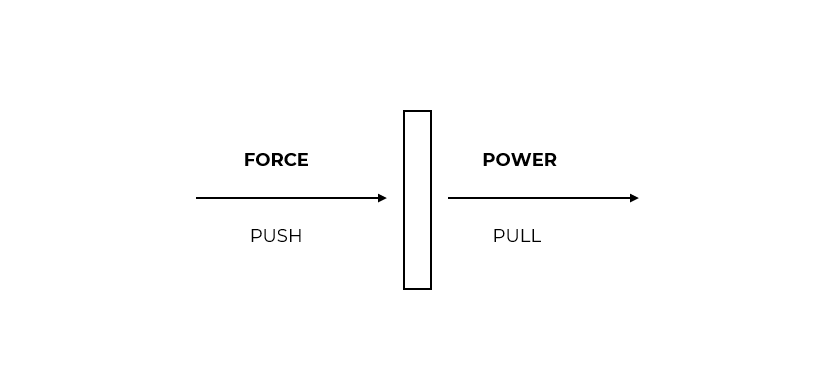
Hawkins identified a core distinction between two ways to move human systems:
Force is push. It is coercive, transactional, and top-down. Force relies on pressure: fear of reprimand, micromanagement, rigid status hierarchies, and CYA (Cover Your Ass) memos. Because force is an external imposition, it always generates an equal and opposite counter-force: passive resistance, cynicism, and friction. It burns immense organizational energy just to keep the status quo alive [1].
Power is pull. It originates from within the system. Power relies on shared context, intrinsic motivation, radical truth, and clear ownership. Power does not demand compliance; it commands alignment. It moves people without creating internal drag [1].
HIGH FRICTION / COMPLIANCE / BURNOUT
[ 20: Shame → 30: Guilt → 50: Apathy → 100: Fear → 125: Desire → 150: Anger → 175: Pride ]
============================ THE THRESHOLD: 200 (COURAGE) ============================
[ 250: Neutrality → 310: Willingness → 350: Acceptance → 400: Reason → 500: Purpose ]
LOW FRICTION / OWNERSHIP / HIGH VELOCITY
The Sub-200 Zone: The Spectrum of Organizational Decay
To understand why traditional corporate headquarters stall, walk up the sub-200 scale from the bottom to the threshold. These are not just emotional states; they are corporate operating cultures.
1. Shame & Guilt (Levels 20–30) — The Blame Machine
At the absolute bottom sits the culture of humiliation. In a Level 20–30 company, failures are met with scapegoating, public eviscerations in executive meetings, and witch-hunts. People operate in full survival mode. The primary skill rewarded here is not execution, but the ability to construct paper trails that push blame onto adjacent departments [2].
2. Apathy (Level 50) — Learned Helplessness
The enterprise equivalent of “quiet quitting.” Teams have experienced so many top-down reorganizations, ignored suggestions, and broken promises that they have given up. Employees punch the clock, execute the bare minimum, and watch catastrophic project failures unfold without raising a finger: “Management didn’t listen last time, so why bother?”
3. Fear (Level 100) — The Bureaucracy of Self-Preservation
The dominant state of legacy enterprise headquarters. Decisions stall because nobody wants their name attached to a mistake [2]. Memos require twenty sign-offs; committees form to evaluate other committees. Risk aversion becomes the rational strategy because the downside of failure is personal termination, while the upside of initiative is marginal [2].
4. Desire (Level 125) — The Mercenary Horizon
The organization is driven by short-term extraction, quarterly bonus optimization, and vanity metrics. Leaders operate like mercenaries rather than stewards: they cut vital R&D or operational maintenance to hit an arbitrary quarterly EBIT target, cash out their incentives, and leave the long-term fallout to their successors.
5. Anger (Level 150) — The Manufactured Crisis
Management by panic and intimidation. Executive leadership relies on aggressive ultimatums, artificial deadlines, and “heads will roll” rhetoric to drive performance. While Anger can produce rapid, short-term bursts of output, it quickly creates systemic burnout, high attrition among top talent, and quiet sabotage from the ranks.
6. Pride (Level 175) — The Status Citadel
Just below the threshold sits the most dangerous corporate state, because it masks dysfunction as sophistication. Level 175 is dominated by the zero-sum status game [3].
Here, organizational energy is consumed by status signaling:
Fighting for the corner office, executive parking spots, or floor privileges.
Obsessing over inflated prefixes (Vice President, Senior Director, Global Head) rather than real impact [4].
Protecting organizational silos and political fiefdoms.
Defending obsolete business models simply because the executive team built their reputations on them.
Pride looks stable on the outside, but it is deeply vulnerable. It rejects outside feedback, ignores customer dissatisfaction, and dismisses disruptive competitors as “inferior” right up until the moment of market collapse [3, 4].
The Fulcrum: Level 200 (Courage)
Level 200 is the point of organizational liftoff. In Hawkins’ model, this is the exact frequency where an entity stops draining energy from its environment and starts creating it [1].
In corporate life, Level 200 is the birth of radical ownership.
At Courage, the organization finally stops defending itself. Employees and leaders stop asking for permission and start taking accountability:
“We built the wrong feature. Here is the post-mortem, and here is how we fix it.”
“This policy slows us down without adding value. Let’s eliminate it.”
“I don’t know how to solve this yet, but I own the outcome and will figure it out.”
Psychological safety, edge-driven decisions, and radical candor cannot exist below Level 200 [2]. Courage is the bridge out of survival mode.
The Super-200 Zone: Engineering High Performance
Once an organization crosses 200, leadership transitions from policing to enablement:
Neutrality (Level 250) — Agility & Non-Attachment: Setbacks are depersonalized. If a vendor defaults or a supply chain breaks, the team doesn’t panic or seek someone to punish. They evaluate the event objectively: “The baseline shifted. What are our three best options?”
Willingness (Level 310) — Frictionless Collaboration: Silos dissolve. People no longer say “That’s not my job.” Teams jump across functional boundaries to fix problems because they genuinely want the mission to succeed. Adaptation is fast, light, and optimistic.
Acceptance (Level 350) — Confronting the Brutal Facts: The organization operates with zero delusion—the corporate embodiment of the Stockdale Paradox [5]. Teams face market realities, declining metrics, and customer churn without defensiveness, while maintaining complete conviction in their ability to prevail.
Reason (Level 400) — First-Principles Synthesis: Decisions are stripped of political posturing. Initiatives are judged on structural logic, systemic data, and first-principles reasoning [6]. The best idea wins, regardless of whether it came from an entry-level analyst or an executive.
How to Lift an Organization Above the Line
You cannot force an organization to be powerful. Using force to solve a force problem simply pushes the culture lower down the scale.
To systematically lift an organization above 200, use this sequence:
1. Stop Responding with Anger and Fear
When performance drops, conventional executives reach for Force: stricter monitoring, more approval gates, threatening reviews, and tighter control. This guarantees failure. If you react to an operational failure with Anger (150), you immediately drag your management team down into Fear (100) and deceit [2].
2. Dismantle the Status Traps (Break Level 175)
Eliminate the physical and linguistic markers of the caste system. Strip away the vanity titles, private dining rooms, and executive silos [4]. Transition to Scope-Based Titles where authority is tied to the perimeter of the problem owned, not the height of the chair. When status loses its currency, political games cease to pay off [3].
3. Normalize Blameless Post-Mortems (Cross Level 200)
Courage requires psychological safety [2]. When an initiative fails, ban the question “Who made this mistake?” Replace it with: “Where did our information, assumptions, or operating systems break down?” When people realize the truth will not end their careers, Fear converts directly into Courage.
4. Lead with Context, Not Control (Target Level 400)
Force requires comprehensive rulebooks; Power requires transparent context [6]. When leaders spend their time clarifying the strategic “Why” (Reason) and push the operational “How” to the edges (Ownership), bureaucracy evaporates and execution speed surges [4, 6].
The Bottom Line
Hawkins’ muscle-testing may remain an eccentric footnote, but his taxonomy of organizational energy is exact.
Every executive memo, every meeting tone, every title policy, and every performance review operates on either Force or Power.
Force requires continuous energy, generates massive organizational friction, and burns people out.
Power aligns incentives, unlocks intrinsic motivation, and accelerates execution.
The objective of modern leadership is not to apply more pressure. It is to remove the systemic friction of the sub-200 zone and lift the entire organization above the line.
References & Supporting Sources
Hawkins, David R. (1995). Power vs. Force: The Hidden Determinants of Human Behavior. Sedona Institute.
(Introduced the Map of Consciousness, articulating the mathematical and psychological distinction between destructive ‘Force’ [<200] and generative ‘Power’ [>200].)Edmondson, Amy C. (2018). The Fearless Organization: Creating Psychological Safety in the Workplace for Learning, Innovation, and Growth. John Wiley & Sons.
(Provides empirical corporate evidence that cultures trapped in Fear and Blame [sub-200] hide critical operational failures, while psychological safety is the foundation of Courage [200].)Ravikant, Naval (in Jorgenson, Eric, 2020). The Almanack of Naval Ravikant: A Guide to Wealth and Happiness. Magrathea Publishing.
(Explores the dynamics of zero-sum ‘status games’—the primary driver of Level 175 Pride—versus positive-sum ownership and value-creation games.)Hamel, Gary & Zanini, Michele (2020). Humanocracy: Creating Organizations as Amazing as the People Inside Them. Harvard Business Review Press.
(Documents the immense organizational drag created by bureaucratic castes, corner-office perks, and vanity titles, offering structural methods to flatten hierarchy.)Collins, Jim (2001). Good to Great: Why Some Companies Make the Leap... and Others Don’t. HarperBusiness.
(Defines the ‘Stockdale Paradox’—the imperative to confront the brutal facts of reality while retaining unwavering faith—which mirrors Hawkins’ Level 350: Acceptance.)Hastings, Reed & Meyer, Erin (2020). No Rules Rules: Netflix and the Culture of Reinvention. Penguin Press.
(Outlines the operational shift from management by control [Force] to management by context [Reason/Power], demonstrating how high-performance organizations operate at the 400+ level.)