


The average lifespan of a multinational corporation is astonishingly short: roughly 40 to 50 years, with modern S&P 500 companies now facing survival horizons closer to 15 to 20 years [1].
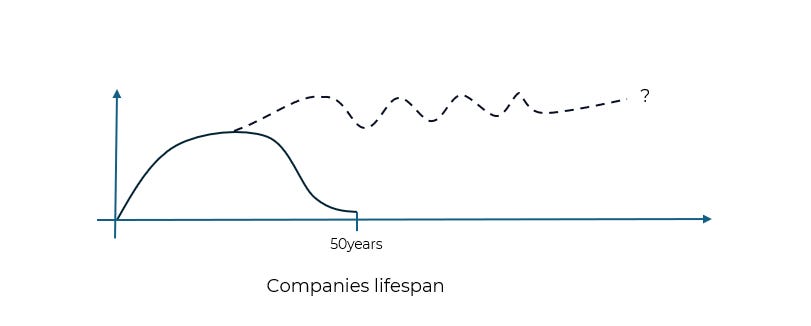
In the late 1980s, Royal Dutch/Shell’s legendary head of strategic planning, Arie de Geus, noticed this corporate mortality crisis and commissioned a study asking a radical question:
Why do almost all corporations die premature deaths, while a rare few—like Stora Enso (operating since the 13th century) or Sumitomo (founded in the 17th century)—survive for hundreds of years across wars, depressions, and industrial revolutions? [1]
In his 1997 classic, The Living Company, de Geus delivered an answer that cuts directly against modern business dogma [1].
Most companies die young because their leaders view them as economic machines—appliances designed purely to extract financial returns for external shareholders [1].
When you view a company as a machine, you optimize every part for short-term efficiency, wring out all redundancy, and treat people as replaceable cogs. But machines cannot adapt. When the market climate changes, a machine cannot evolve; it breaks [1, 2].
The companies that survive centuries operate on an entirely different mental model: they operate as living organisms [1].
The Four Pillars of the Living Company
De Geus discovered that enduring enterprises prioritize survival, learning, and self-perpetuation over pure quarterly extraction. Across hundreds of years of data, these living companies share four distinct operational traits [1]:
[ 1. SENSITIVITY ]   ──→  Learning & Sensing Weak Signals at the Edge
         │
[ 2. IDENTITY    ]   ──→  Cohesion Around Purpose, Not Fixed Products
         │
[ 3. TOLERANCE   ]   ──→  Decentralized Experimentation & Slack
         │
[ 4. FRUGALITY   ]   ──→  Conservative Financing & Self-Determination
1. Sensitivity to the Environment (Learning Velocity)
Living companies have hypersensitive nervous systems [1]. They don’t rely solely on backward-looking financial metrics from headquarters; they listen to weak signals at the periphery.
This was the origin of Shell’s pioneering Scenario Planning: using future narratives not to predict what will happen, but to train management’s mental models to recognize reality faster when it shifts [1, 2]. As de Geus famously concluded: “The ability to learn faster than your competitors may be the only sustainable competitive advantage” [1].
2. Cohesive Identity (The Idea That Outlives the Product)
Long-lived companies do not tie their soul to an assembly line. Stora started as a copper mine in Sweden, evolved into forestry and paper, and transitioned into renewable materials [1].
Employees across generations felt bound to a shared community, ethos, and standard—not a specific product catalogue [1]. In an “economic machine,” workers are rented labor. In a “living company,” people belong to a self-perpetuating community of destiny.
3. Tolerance (Decentralization & Necessary Slack)
Machines demand total control, strict uniformity, and zero waste. Living systems require ecological tolerance [1, 3].
Living companies allow “messiness” at the edge: eccentric projects, local autonomy, and experiments that don’t fit current KPIs [1]. Over-optimized systems have no immune system against black swan events [3]. Tolerance is the genetic reservoir from which the next business model emerges.
4. Conservative Financing (Autonomy Over Leverage)
Living companies are obsessively frugal with external debt [1]. They understand that borrowing heavily to goose short-term returns surrenders sovereignty to outside lenders. By maintaining cash reserves and controlling their own balance sheet, they preserve the freedom to navigate multi-year downturns without being liquidated by creditors [1, 3].
The Lesson for High-Performing Teams
We are living through an era of corporate hyper-optimization: financial engineering, endless re-orgs, and algorithms measuring every keystroke.
Managers think they are building hyper-efficient engines. In reality, they are building brittle machines on the brink of catastrophic failure [1, 3].
If you run your team like an engine, you redline it until the components snap.
If you cultivate your team like an organism:
You stop micromanaging and start distributing sensory awareness to the edges.
You leave room for trial, error, and experimentation.
You anchor people to an unshakeable standard and purpose rather than a temporary process.
Machines perform until they break. Living organisms adapt, regenerate, and endure.
References & Supporting Sources
De Geus, Arie (1997). The Living Company: Habits for Survival in a Turbulent Business World. Boston: Harvard Business School Press.
(The seminal text synthesizing Shell’s landmark study of long-lived enterprises, contrasting brittle ‘economic companies’ with adaptive, resilient ‘living companies’.)Senge, Peter M. (1990). The Fifth Discipline: The Art & Practice of The Learning Organization. New York: Doubleday/Currency.
(Explores systemic thinking and mental models, echoing de Geus’s insight that competitive durability depends on an organization’s collective learning velocity.)Taleb, Nassim Nicholas (2012). Antifragile: Things That Gain from Disorder. New York: Random House.
(Provides the modern mathematical and operational foundation showing that hyper-optimized, debt-laden systems are inherently fragile, whereas living systems require redundancy and decentralized experimentation to thrive under stress.)