


If you asked someone in 1950 to draw a company, they would draw a triangle. The Pyramid.
Pharaohs used them to store bodies, and the Industrial Revolution used them to store power. The logic was simple: thinking happens at the top, doing happens at the bottom. But in a world that moves at the speed of light, the signal from the top takes too long to reach the bottom.
Today, the highest-performing teams aren’t shapes. They are networks.
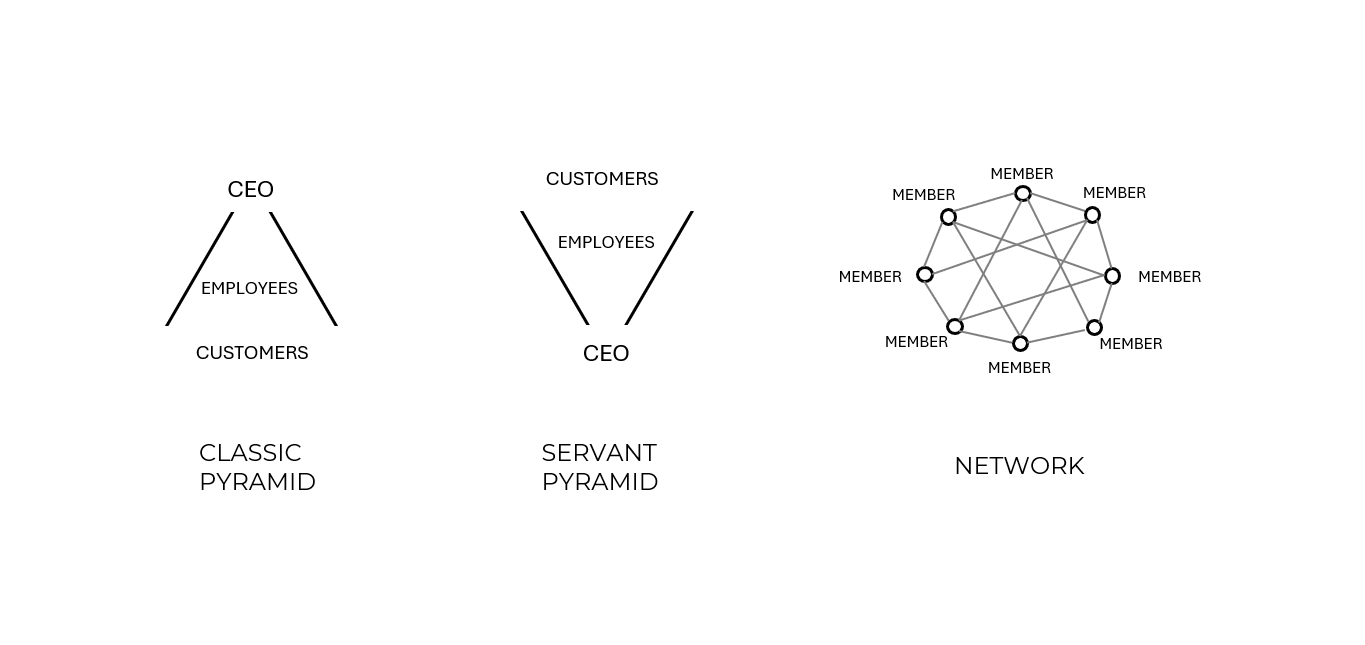
Here is how we are evolving from the rigid machine to the living swarm—and why the best leaders are destroying the organizational chart.
1. The Traditional Pyramid: “Command and Control”
This is the legacy model. It offered stability and clarity for the Industrial Age.
The Structure: Rigid hierarchy. Status is the currency. People fight for a better title, a corner office, and a larger budget.
The Flaw: It separates the brain from the hand. In a pyramid, innovation dies in the middle management layer, and energy is wasted on internal politics rather than external value.
2. The Inverted Pyramid: “The Servant Leader”
The first major crack in the pyramid came from Peter Drucker.
In his seminal work, The Practice of Management, Drucker introduced the concept of the “Knowledge Worker.” He realized that in the modern economy, the worker often knows more about the job than the boss does.
This led to the “Inverted Pyramid” or Servant Leadership model.
The Concept: The CEO is at the bottom, supporting the managers, who support the frontline employees, who serve the customer.
The Benefit: It humanizes work. It changes the question from “How do I please my boss?” to “How do I help my team?”
The Flaw: While it improves the culture, it doesn’t fundamentally change the physics of decision-making. It is still a hierarchy, just a benevolent one.
3. The Network: “The Mission is the Boss”
This is the revolution. In the network model, there are no “employees” and “managers.” There are only members and nodes.
This is the philosophy that powers NVIDIA. Jensen Huang, the CEO of the world’s most valuable company, famously runs a flat organization with over 60 direct reports, rejecting the traditional hierarchy of status.
Jensen’s rule is simple: “The Mission is the Boss.”
When the Mission is the boss, the organizational chart becomes irrelevant. You don’t need to fight for status because status doesn’t get the job done—information does. You don’t wait for permission from a VP; you ask, “Does this serve the mission?” If the answer is yes, you act.
The “Teal” Effect: In Reinventing Organizations, Frederic Laloux describes this as the Teal Organization. It operates like a living organism. Decisions are made by the people closest to the problem (the “advice process”), not the people with the highest salary.
The “Swarm” Effect: Rick Falkvinge, in Swarmwise, describes how decentralized networks (swarms) outperform massive, funded hierarchies. In a swarm, nobody fights for titles because titles are irrelevant to the outcome.
Why the Network Wins
In a traditional company, the “Boss” is a person. You negotiate with them, you try to impress them, you fear them. This creates friction.
In a Network like NVIDIA or a Swarm, the hierarchy is fluid. Leaders emerge based on contribution, not position.
The transition is scary. It requires trusting that people are adults who want to contribute. But once you stop managing people and start managing the network, you don’t just get a better team. You get a movement.
References
[1] Drucker, Peter F. The Practice of Management. Harper & Row, 1954. (The foundational text where Drucker defines the Knowledge Worker and shifts the focus from “labor” to “human capital”).
[2] Huang, Jensen. (Philosophy on Management). The NVIDIA Way. See recent interviews (e.g., Acquired Podcast or Stanford GSB) where Huang discusses that “no task is beneath him” and that the “project is the boss,” eliminating the need for 1-on-1s and status reports.
[3] Laloux, Frederic. Reinventing Organizations: A Guide to Creating Organizations Inspired by the Next Stage of Human Consciousness. Nelson Parker, 2014. (The guide to self-management and “Teal” organizations).
[4] Falkvinge, Rick. Swarmwise: The Tactical Manual to Changing the World. 2013. (A practical guide on leading decentralized networks where the mission drives the activity).