


When organizations map their core business processes for standard quality management certifications, they often get lost in a sea of minor workflows. However, the most resilient enterprises simplify their operational map down to two foundational pillars: New Product Introduction (NPI) and Product Execution.
Of the two, NPI is the more challenging endeavor.
It is the primary engine of future growth, but it is also a notorious company-killer. History is littered with failed product launches where the product-market fit was missed, development costs went out of control, or organizational delays killed the project before it ever reached the market.
To execute NPI successfully, an organization must align its strategic vision with its tactical execution engine. This requires defining distinct roles, establishing clear lines of ownership, and designing a structure that bridges traditional corporate silos.
1. The Cost of Delay: How Silos Interfere with Timing
In studies of high-profile corporate product failures, researchers like Sydney Finkelstein have noted that NPI challenges are rarely caused by a lack of technical capability [1]. Instead, they are frequently caused by organizational friction that slows decision-making. In fast-moving markets, a delayed launch can be as costly as a flawed product.
Consider two historical examples where organizational alignment and timing issues impacted market viability:
Nokia and the MeeGo Transition: In the late 2000s, Nokia sought to address the shifting smartphone landscape by developing a next-generation operating system called MeeGo. However, Nokia’s vertical, siloed organization required extensive cross-departmental reviews and consensus-building. Decisions moved slowly, and the MeeGo NPI faced repeated delays. By the time it was ready for release, alternative ecosystems had established dominant market share, prompting Nokia to shift its device strategy entirely [1].
The Sega Dreamcast: Launched in 1998, the Dreamcast was a highly advanced gaming console for its time. However, internal misalignment and coordination issues with component manufacturing delayed the initial production run. These delays led to limited inventory at launch, leaving room for competitors to build anticipation for their own upcoming platforms and capture market momentum [1].
These cases highlight a common organizational challenge: traditional, highly hierarchical structures can struggle to support the rapid cross-functional alignment required for modern NPI.
2. The Two Essential Roles: Why You Must Never Combine the PM and IPL
To execute NPI successfully, an organization must separate the strategic brain of the category from its tactical execution engine. This requires two distinct roles with entirely different cognitive horizons.
                    ┌─────────────────────────┐
                    │    Category Strategy    │
                    │  Product Manager (PM)   │
                    └────────────┬────────────┘
                                 │
                   [Strategic alignment on What/Why]
                                 │
                                 ▼
                    ┌─────────────────────────┐
                    │  Tactical Execution     │
                    │  Project Leader (IPL)   │
                    └─────────────────────────┘
The Product Manager (PM): The Strategic Core
The PM is the strategic owner of the category. Rather than operating within a single functional department, they serve as a central hub connecting Sales, Marketing, and Finance. The PM’s focus is external and future-oriented. They define the what and the why:
Market Strategy: Identifying target customer segments, understanding competitor offerings, and identifying market gaps.
Value Proposition: Defining the core features required to solve the customer’s problem effectively.
Financial Guardrails: Determining the target price point, maximum manufacturing costs, and required margin structures to ensure the product’s business case is viable.
The Integral Project Leader (IPL): The Tactical Catalyst
The IPL is the pilot in command of the specific NPI project. Their focus is internal and present-oriented. They do not manage market segmentation; they own the how and the when.
The IPL operates similarly to Apple’s “Directly Responsible Individual” (DRI) [2] or Amazon’s “Single-Threaded Leader” (STL) [3]. They bear ultimate responsibility for delivering the project on time, within budget, and to the required quality specifications. Their responsibilities include:
The Critical Path: Managing technical trade-offs, engineering sprints, tooling schedules, and validation testing.
Resource Coordination: Proactively securing the necessary engineering and manufacturing resources (such as factory floor time for test runs).
Phase-Gate Governance: Ensuring the product meets established quality and manufacturing standards before moving to the next stage of development.
The Fatal Mistake: Combining the Roles
Many organizations attempt to save headcount by combining the PM and IPL roles. This is a critical structural error.
These two roles require fundamentally different mindsets. A PM must spend their time looking outward and forward. An IPL must focus inward on the day-to-day execution.
When combined, the urgent always eats the important. The daily firefighting of project management—such as tracking down a delayed component or resolving an engineering bug—will inevitably consume the individual’s time. Consequently, long-term strategic tasks like customer discovery, margin optimization, and market positioning are neglected, leading to technically sound products that fail to find a market.
3. The “Leader-Leader” Model: Bridging Category Leadership and Executive Functions
How does a decentralized, category-driven team operate without getting bogged down by traditional executive approval loops? The answer lies in shifting the relationship between the Category Leaders (PM and IPL) and traditional C-suite functions (CTO, CFO, COO).
In Turn the Ship Around!, former nuclear submarine commander L. David Marquet introduces the “Leader-Leader” model [4]. Instead of a top-down “Leader-Follower” culture where team members wait to be told what to do, control is pushed down to those who have the actual information [4].
This framework is highly effective for governing the interface between the Diamond Team and senior executives:
Traditional (Leader-Follower Approval Loops):
[Diamond Team] ── "May we change the spec/budget?" ──> [C-Suite (CTO/CFO)] ──> (Weeks of review/delay)

Modern (Leader-Leader Intent-Based Decision Making):
[Diamond Team] ── "We intend to shift the launch window/budget." ──> [C-Suite (CTO/CFO)] ──> (Strategic alignment/Clearance)
Instead of asking executive leaders for permission, the PM and IPL operate on the mechanism of “I intend to...” [4].
The PM to the CFO: “To capitalize on an emerging competitor vulnerability, I intend to shift $50k of our allocated marketing budget from Q4 to Q3.”
The IPL to the CTO: “Based on our validation testing, I intend to freeze the software architecture on Friday and schedule the pre-production build.”
In this model, the CFO, CTO, or VP of Operations do not micro-manage the tactical execution of the project. Their role is to ensure these intentions do not violate global organizational guardrails (such as cash flow limits or broader technical architecture standards) and then to provide the institutional resources to make it happen. This structural autonomy is what allows the category team to move at market speed.
4. The Diamond Team Structure
To support this autonomous model, the PM and IPL are integrated into a permanent lateral structure: The Diamond Team [5].
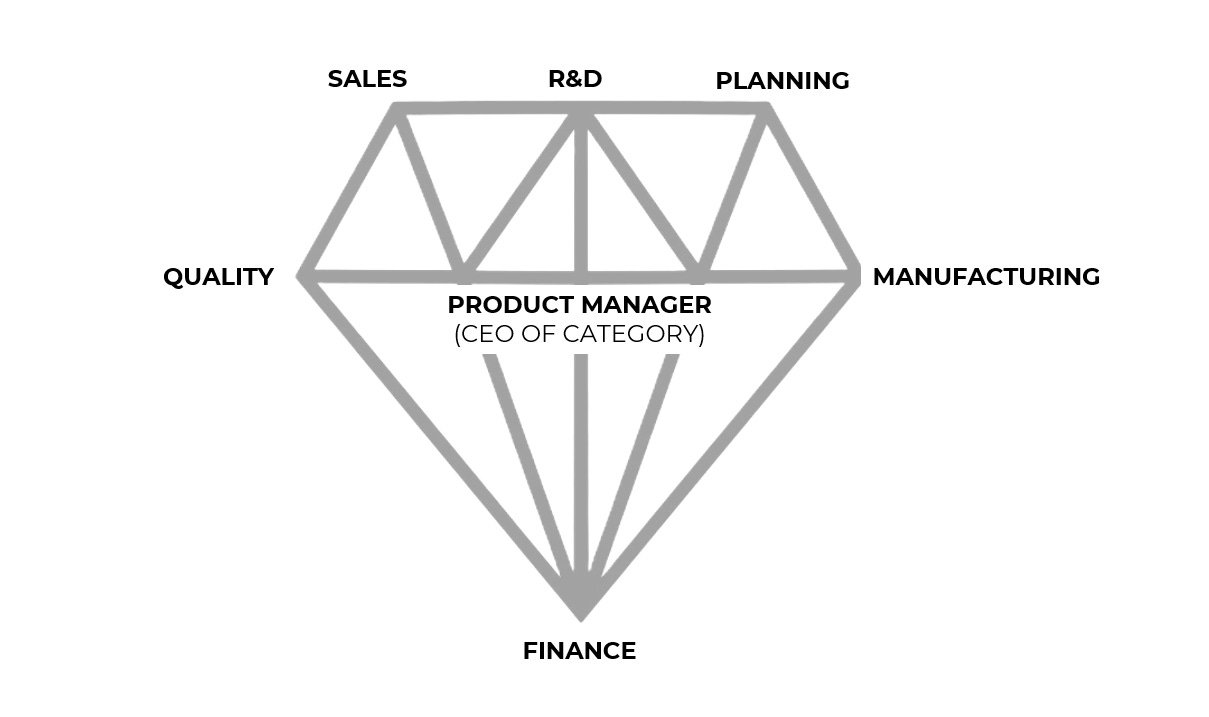
The Diamond Team is a dedicated, cross-functional unit organized around a specific product group or category. It functions as a focused startup within the larger organization.
Each major department (Sales, R&D, Marketing, Operations, and Finance) assigns a representative to the team. While these representatives maintain a reporting relationship to their functional departments for professional standards, their primary day-to-day accountability is to the Diamond Team’s mission.
This structure offers two key organizational advantages:
End-to-End Ownership: The team manages the business of that category throughout its lifecycle, ensuring continuous alignment between market demand and operational capability.
Mitigation of Volume Bias: In The Innovator’s Dilemma, Clayton Christensen explained how established companies naturally prioritize resources for high-volume, high-margin legacy products, often starving newer initiatives [6]. The Diamond Team model ensures that developing categories have dedicated advocates, protecting them from being overlooked in favor of mature business lines.
5. The Role of Executive Leadership: The Board, Not the Boss
If the Product Manager owns the category strategy, the IPL drives the project, and the Diamond Team operates autonomously using the “I intend to” model, the role of executive leadership must shift.
In this model, frequent intervention by the LT in daily operational decisions is often a sign of underlying organizational friction [4]. Instead, the LT functions similarly to an internal Board of Directors or an investment committee:
Strategic Capital Allocation: Evaluating business cases developed by the Diamond Teams and allocating funding based on strategic alignment and projected returns.
Coaching and Inquiry: Guiding teams by asking clarifying questions to help them stress-test their business models, risk assessments, and launch plans [4].
Portfolio Governance: Monitoring the overall product portfolio, identifying when market shifts require entering new categories, and establishing new Diamond Teams to pursue those opportunities.
By shifting from a model of direct control to one of strategic stewardship, executive leaders can foster a more agile organization—allowing those closest to the market to drive execution and growth.
6. Review Structure
It is important (especially at the beginning) to set up the proper review structure. The Product Manager and the Diamond team needs to learn what actually they own. The Leadership needs to learn how to coach and not “manage”.
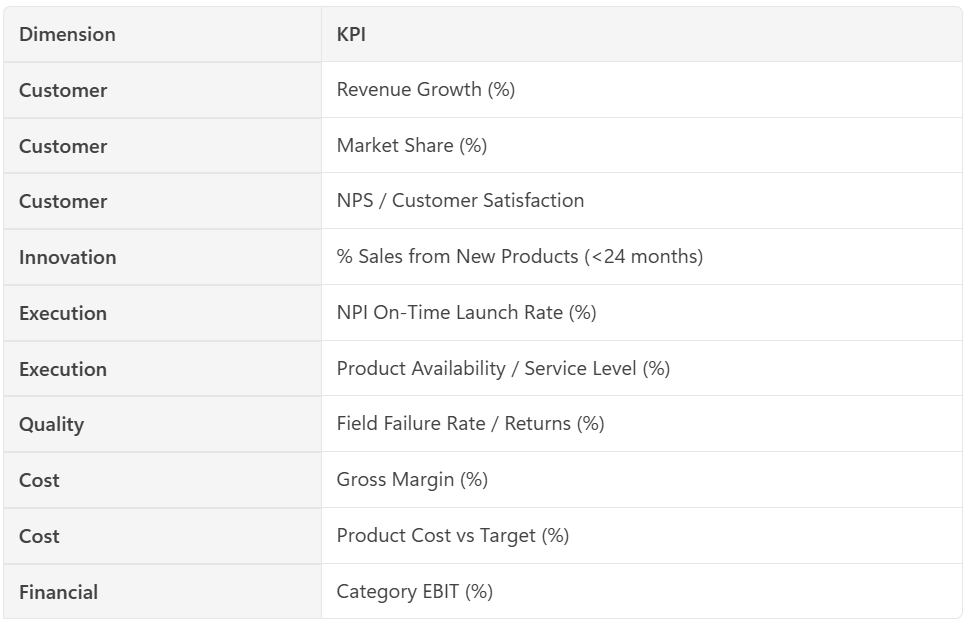
Monthly Reviews where the Diamond Teams present their status to the Leadership team can be a good platform to do both.
The KPI dashboard can facilitate the discussion and create the ownership for entire end 2 end business. An Example of KPI is presented below:
I would advise you to let it try and let it go. The power of small and dedicated teams is superb. At the end i think the best it is described by Salim Ismail [7]: “Give us small, ambitions team, with MTP (massive transformative purpose), give them access to shared facilities (…) and let them go, they will do amazing things”
Sources & References
[1] Finkelstein, S. (2003). Why Smart Executives Fail: And What You Can Learn from Their Mistakes. Portfolio. (Case studies on execution, coordination challenges, and market entry timing).
[2] Lashinsky, A. (2012). Inside Apple: How America’s Most Admired--and Secretive--Company Really Works. International Business Times. (Details on the “Directly Responsible Individual” ownership framework).
[3] Bryar, C., & Carr, B. (2021). Working Backwards: Insights, Stories, and Secrets from Inside Amazon. St. Martin’s Press. (Analysis of the “Single-Threaded Leader” model of accountability).
[4] Marquet, L. D. (2012). Turn the Ship Around!: A True Story of Turning Followers into Leaders. Portfolio. (Developing decentralized decision-making and the “I intend to...” framework).
[5] Galbraith, J. R. (2002). Designing Organizations: An Executive Guide to Strategy, Structure, and Process. Jossey-Bass. (Design principles for lateral relations, cross-functional teams, and matrix structures).
[6] Christensen, C. M. (1997). The Innovator’s Dilemma: When New Technologies Cause Great Firms to Fail. Harvard Business Review Press. (Analysis of resource allocation patterns and resource challenges for developing initiatives).
[7] Diamandis P. Moonshots podcast. Moonshots with Peter Diamandis