


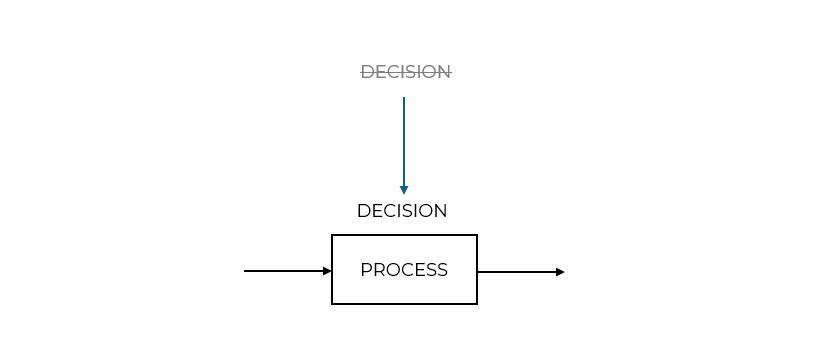
When organizations seek to improve operational speed and agility, they often resort to restructuring their departments or rewriting their processes. However, the most resilient enterprises understand that true agility is not a matter of restructuring lines on an organizational chart—it is a matter of shifting where decisions are made.
The high-performing organizations of the modern era do not rely on central control to drive execution. Instead, they push decision-making authority down to those who are closest to the process.
To build an organization capable of operating at market speed, leadership must transition from a model of command-and-control to one of distributed autonomy.
1. The High Cost of Centralized Control
In complex, fast-moving environments, the primary bottleneck to execution is information transit.
In traditional hierarchical structures, information must travel up the organizational pyramid to reach a decision-maker, and the resulting instruction must then travel back down to the frontline. By the time this loop is completed, the external reality has often changed, rendering the decision obsolete.
Consider the contrasting models of operation in elite military units:
Top-Down vs. From Within: In their analysis of high-performing, decentralized teams, researchers like Steven Kotler and Jamie Wheal have examined the operational mechanisms of elite units like the Navy SEALs [1]. In traditional military configurations, units are directed from a central command post. SEAL teams, however, operate using a model of “distributed command” or “communitas”—where the leadership on the ground is fluid, shifting dynamically to whoever has the best immediate perspective on the tactical situation [1].
This is not a lack of structure; it is a highly disciplined form of dynamic alignment. When the operator closest to the target has the authority to make tactical adjustments without waiting for permission from headquarters, the team’s operational speed increases exponentially.
2. Shifting the Control Mechanism: From Permission to Intent
How does a business replicate this level of responsiveness without descending into chaos? The answer lies in shifting the fundamental linguistic interface between teams and executive leadership.
In Turn the Ship Around!, former nuclear submarine commander L. David Marquet introduces the “Leader-Leader” model [2]. Marquet argues that traditional hierarchies are built on “Leader-Follower” approval loops, which foster passive compliance and slow down execution. To break this cycle, organizations must replace the request for permission with the statement of intent [2].
Traditional (Leader-Follower Approval Loops):
[Frontline] ── "May we take action?"──>[Management] ──> (Delays&Information Loss) ──> [Approval]

Modern (Leader-Leader Intent-Based Decision Making):
[Frontline] ── "We intend to act." ──> [Management] ──> (Context Check & Clearance) ──> [Action]
In an intent-based organization, the operational dialogue changes completely:
The Software Team: Instead of asking, “Can we deploy this update on Tuesday?” they state, “Based on our successful staging tests, we intend to deploy the update on Tuesday at 02:00.”
The Procurement Lead: Instead of asking, “Can we approve this supplier deviation?” they state, “To protect the production schedule from shipping delays, we intend to source the alternative component from Supplier B.”
The role of the manager in this model is not to analyze the technical details of the decision, but to verify that the team has the necessary context and competence to make it safely. If the team is competent and the decision aligns with the strategic direction, the manager simply clears the path.
3. Networked Autonomy: Swarms and Teal Models
When we push this decentralized philosophy to its logical conclusion, we move past traditional matrix organizations and enter the realm of networked, self-organizing systems.
Hierarchical Model:                     Networked/Teal Model:
       [CEO]                                  ┌───┐   ┌───┐
         │                                    │   ├───┤   │
     ┌───┴───┐                                └─┬─┘   └─┬─┘
   [VP1]   [VP2]                                │   ┌───┐ │
     │       │                                ┌─┴───┤   ├─┴─┐
   [Mgr]   [Mgr]                              │     └───┘   │
  ┌──┴──┐ ┌──┴──┐                             └─────────────┘
  [F]   [F] [F] [F]                       (Distributed Nodes)
In Reinventing Organizations, Frederic Laloux outlines the emergence of “Teal” organizations—structures that replace hierarchical oversight with peer-based networks [3]. These enterprises do not rely on traditional management positions to enforce accountability. Instead, they use peer-advice processes where any employee can make a decision, provided they seek advice from those who will be impacted and those with expertise in the matter [3].
Similarly, in Swarmwise, Rick Falkvinge describes the mechanics of highly scalable, self-driven “swarms” [4]. In a swarm-based structure:
Execution is horizontal: Teams form organically around specific missions or goals.
The network is agile: Because there are no management layers to navigate, information flows laterally, allowing the organization to pivot, scale, and respond to threats far faster than a legacy competitor.
4. The Evolving Role of Executive Leadership: From Boss to Architect
If the frontline teams are self-directed, and decisions are made using the “I intend to...” model, does the organization still need a traditional Leadership Team (LT)?
The answer is yes, but the nature of their work changes fundamentally. In a highly decentralized system, the LT does not manage current operations. Instead, their role is to design and maintain the system itself.
Operational DimensionTraditional Leadership TeamModern / Decentralized Leadership TeamFocusManaging the Present (KPIs, schedules, approvals)Living in the Future (strategy, horizon scanning, capability building)AuthorityCommand and Control (deciding how work is done)Context and Coaching (deciding why and where the company goes)CommunicationDirectives and ApprovalsClarifying Questions and Strategic Direction
By stepping back from daily operational choices, executive leaders gain the cognitive bandwidth required to focus on long-term strategy, market shifts, and capital allocation.
5. Establishing the Guardrails: How to Build Trust Safely
For decentralization to work, the organization must establish highly visible guardrails. Trust without verification is not autonomy—it is negligence.
To transition successfully, organizations should implement two core practices:
Establish Clear Competence Metrics: Before a team can operate on “I intend to,” they must prove they possess the technical competence and operational clarity required to make the decision [2].
Implement Monthly Peer Reviews: Rather than using reviews to judge past performance, use them as coaching platforms. The Leadership Team’s role in these reviews is to ask questions that help the teams stress-test their own models and assumptions.
When these guardrails are in place, the speed of the enterprise increases dramatically.
Conclusion
The power of small, dedicated, and autonomous teams is difficult to overstate. When you strip away the layers of approval and allow the people closest to the process to guide execution, the organization becomes both more resilient and highly responsive.
As Salim Ismail notes on the structural advantages of modern, scalable enterprises:
“Give us a small, ambitious team with a Massive Transformative Purpose (MTP), give them access to shared facilities, and let them go—they will do amazing things” [5].
The role of leadership is not to direct these teams, but to build the arena in which they can run.
Sources & References
[1] Kotler, S., & Wheal, J. (2017). Stealing Fire: How Silicon Valley, the Navy SEALs, and Maverick Scientists Are Revolutionizing the Way We Live and Work. Harper Wave. (Analysis of decentralized decision-making and flow states in high-stakes operational environments).
[2] Marquet, L. D. (2012). Turn the Ship Around!: A True Story of Turning Followers into Leaders. Portfolio. (Developing the “Leader-Leader” framework and intent-based communication systems).
[3] Laloux, F. (2014). Reinventing Organizations: A Guide to Creating Organizations Inspired by the Next Stage of Human Consciousness. Nelson Parker. (Case studies on Teal organizations, self-management, and peer-advice models).
[4] Falkvinge, R. (2013). Swarmwise: The Tactical Manual to Changing the World. Chapter Two Books. (Design and coordination principles for horizontal, highly autonomous organization networks).
[5] Ismail, S. (2014). Exponential Organizations: Why new organizations are ten times better, faster, and cheaper than yours (and what to do about it). Diversion Books. (Exploration of MTPs and the leverage of decentralized, agile teams).