


“Perfection is not attainable, but if we chase perfection, we can catch excellence.” This famous quote belongs to Vince Lombardi, the legendary coach of the NFL’s Green Bay Packers [1]. His relentless pursuit of perfection reshaped the team, leading them to multiple Super Bowl titles and cementing his legacy as a disciplinarian who demanded absolute precision.
In stark contrast, consider this advice: “Stop thinking you have to be perfect. You don’t have to be perfect. You don’t have to be great. You just have to be better than the guy on the other side of the net.” These are the words Brad Gilbert spoke to Andre Agassi during a critical slump in 1994. This conversation is widely considered the turning point in Agassi’s career, ultimately propelling him to become the #1 tennis player in the world [2].
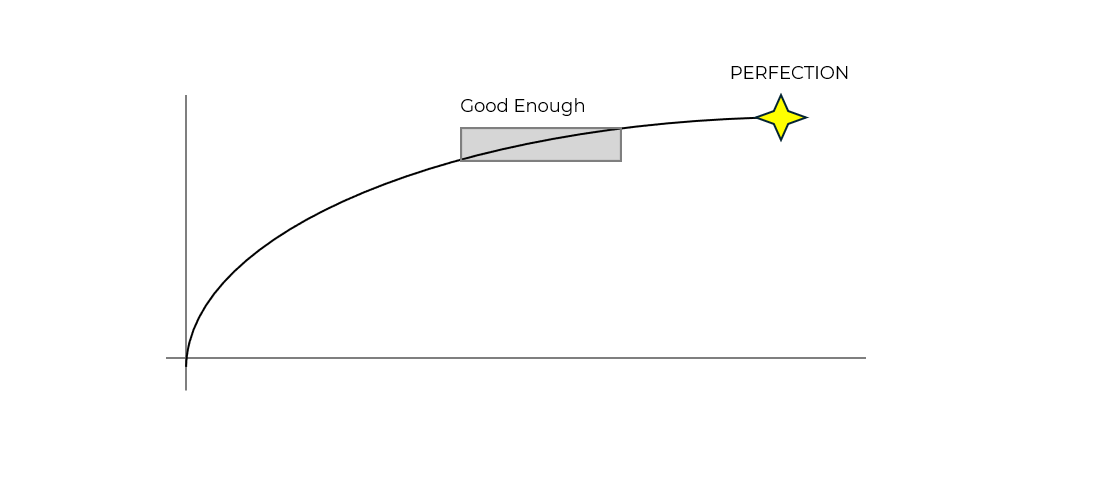
Isn’t this a contradiction? Isn’t it common sense that a team must strive for perfection to reach excellence? Can you reach the moon if you do not shoot for the stars?
But wait—how many times have entire teams, or even massive companies, spent months developing a “perfect” product or service, only to see a competitor launch something similar first? Maybe the competitor’s product was slightly less “perfect,” but it was already out there. This is the classic dilemma between the concept of “first time right” versus “good enough and improve.” Perhaps it is more logical to launch an MVP (Minimum Viable Product) before pouring more effort into the creation of mastery.
I experienced this dilemma firsthand at Philips, where we had a company-wide competition for “best projects.” At the time, I was a young engineer and had gathered a small “self-improvement team” to introduce a new idea as a DMAIC project for the competition. As the leader, one of my tasks was to prepare the PowerPoint presentation. Striving for perfection, I spent hours mastering every detail of every slide. I organized multiple “feedback sessions,” after which I received even more comments on what to fix.
At a certain point, the slides became more important than the improvement itself—the actual content of the project. I eventually learned that even if I put in ten more hours, the slides would only be marginally better. I should have stopped earlier; I had lost too much time. It was my personal lesson that perfection is not always the way.
So, which strategy should we follow when building High Performing Teams?
The answer is that these are not opposing strategies. In fact, one is a supplement to the other. If we want to be the best we can be, the image of “perfection” is a powerful tool. It serves as a direction and a compass; it is an antidote against settling for temporary success or mediocrity. This mindset provides the fuel to keep going because there is always a way to make things better.
On the other hand, the idea of perfection should not stop our progress. Sometimes we simply need to present our current best to the world, get feedback, learn, and improve—one step at a time. Progress is often more important than initial velocity.
As NBA legend Bill Russell discussed in his philosophy on winning, you must commit to learning and improving every single day [3]. You set the standard high, but you focus on the work. Surfing on that edge—between the pursuit of the ideal and the reality of the game—is where the fun and energy truly live.
References
[1] Lombardi, Vince. (Quote attributed). See also: Phillips, Donald T. Run to Win: Vince Lombardi on Coaching and Leadership. St. Martin’s Griffin, 2001. (Lombardi’s philosophy on perfection is a central theme throughout his biographies and recorded speeches).
[2] Agassi, Andre. Open: An Autobiography. Knopf, 2009. (The specific conversation with Brad Gilbert takes place in Chapter 16, where Gilbert explains that Agassi’s need for perfection is causing him to lose to inferior players).
[3] Russell, Bill, and Branch, Taylor. Second Wind: The Memoirs of an Opinionated Man. Random House, 1979; or Russell, Bill. The Russell Rules: 11 Lessons on Leadership from the Twentieth Century’s Greatest Winner. Dutton, 2001. (Russell frequently wrote that consistency and psychological resilience were more important than occasional flashes of perfect play).