


Watch what happens inside an executive conference room when a critical project falls behind schedule:
A Vice President crosses their arms and lectures the room on discipline, accountability, and missed deadlines. Across the table, a director looks down at their notebook in silence, nodding defensively. In the hallway afterward, the team vents in private Slack channels, quietly rolling their eyes and waiting to be told what to do next.
This is not an anomaly. It is the default setting of corporate life.
We hire brilliant, highly paid adults with advanced degrees and decades of experience. The moment they cross the threshold of a corporate headquarters, however, the system strips them of their agency and locks them into an emotional kindergarten.
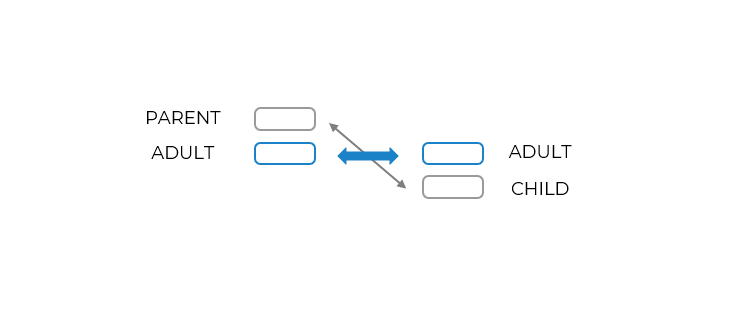
To diagnose why this happens—and how high-performing teams break the cycle—we don’t need another convoluted HR competency matrix. We need a simple, 60-year-old mental model: Transactional Analysis (TA).
The PAC Model: Eric Berne’s Operating System
Developed in the late 1950s by Canadian psychiatrist Eric Berne, Transactional Analysis posits that every human interaction is driven by one of three internal “ego states” [1]:
[ PARENT ]  ──→  Rules, Judgment, Tradition, Nurturing / Scolding
     │
[ ADULT  ]  ──→  Logic, Reality-Testing, Data, Non-Emotional Problem Solving
     │
[ CHILD  ]  ──→  Fear, Rebellion, Compliance, Spontaneity, Seeking Approval
The Parent State (Copied Reality): Behaviors, thoughts, and feelings copied from authority figures. In the workplace, this splits into:
The Critical Parent: Evaluates, judges, scolds, sets rigid rules, and micromanages (“You cannot! submit this without my sign-off”).
The Rescuing Parent: Overprotects, hoards work, and shields subordinates from natural consequences (“Don’t worry, give it to me, I’ll fix it for you”).
The Child State (Relived Reality): Emotional reactions and survival strategies learned in childhood:
The Adapted Child: Submissive, compliant, risk-averse, and constantly seeking validation (“Just tell me what you want on the slide, I’ll do it”).
The Rebellious Child: Passive-aggressive, cynical, pushing back against rules simply because they exist (“Management has no idea what they’re doing, so why bother?”).
The Adult State (Direct Reality): Objective, autonomous, and analytical. The Adult evaluates reality as it is—without emotional baggage, moralizing, or defensive posturing. It processes information, calculates probabilities, and focuses entirely on solving the problem [1, 2].
The Architecture of the Pyramid: Institutionalizing Parent-Child
The traditional 20th-century corporate pyramid was not built for autonomy; it was built for control [3]. By its very design, it institutionalizes Parent-to-Child transactions.
Consider the everyday mechanics of corporate headquarters:
Expense Policies: Requiring three executive signatures to purchase a €50 technical book tells the employee: “We view you as an untrustworthy Child who must ask for pocket money.”
Annual Performance Reviews: A manager sitting across a desk rating an employee’s “attitude” on a 1-to-5 scale is an exact replay of a Critical Parent handing out a grade school report card [3].
Approval Gates: Requiring a steering committee to validate basic operational decisions teaches employees learned helplessness.
TRADITIONAL PYRAMID:                 HIGH-PERFORMING NETWORK:
   [ Manager / PARENT ]                  [ Node A / ADULT ]
           │                                     ▲
           ▼ (Command / Scold)                   │ (Direct Contract / Truth)
           │                                     ▼
   [ Employee / CHILD ]                  [ Node B / ADULT ]
When an organization defaults to the Parent-Child dynamic, ownership is structurally impossible.
You cannot demand that employees “act like entrepreneurs” while subjecting them to systems designed for errant teenagers [3, 4]. A Critical Parent demands an Adapted Child. If a manager acts like an overbearing guardian, employees will naturally retreat into passive compliance, waiting for explicit instructions so they cannot be blamed if the project fails [4].
The Network Alternative: The Adult-to-Adult Standard
High-performing teams do not operate as paternalistic hierarchies; they operate as decentralized networks of sovereign professionals [5].
In a high-performing network, the foundational operating protocol is Adult-to-Adult [1, 2].
What does this look like in practice?
Interaction Area: Traditional Pyramid (Parent → Child)
High-Performing Team (Adult ↔ Adult)
Delegation
“Here is the template. Follow it exactly and show me before you send it.” (Parent).
“Here is the business objective and context. You own the perimeter. How do you plan to approach it?” (Adult).
Mistakes
“Who authorized this? How could you let this happen?” (Critical Parent).
“Here is the data. The output missed the target. What failed in our assumptions, and how do we adjust?” (Adult).
Pushback
Silent agreement in the room, cynical complaining in the corridor. (Child)
Direct, unemotional confrontation of facts in the room. (Adult)
Accountability
Punitive reviews and surveillance. (Parent)
Transparent peer commitments and shared metrics. (Adult)
In an Adult-to-Adult culture, emotions are depersonalized.
Feedback is not a moral judgment on a person’s worth; it is data regarding system performance [2]. Disagreements are not viewed as insubordination; they are treated as intellectual calibration [4].
How Leaders Break the Parent-Child Reflex
Shifting an organization from Parent-Child to Adult-Adult does not happen through a culture memo. It requires leaders to systematically refuse to play the Parent role.
Here are three operational interventions to force the transition:
1. Stop Rescuing; Start Contracting
In Transactional Analysis, healthy collaboration requires explicit, mutual contracts [1].
When an employee comes to your desk saying, “We have a problem with the European supplier, what should I do?”, their instinct is to slip into the Child state and pass the monkey to the Parent.
If you answer with the solution, you validate the dynamic.
The Adult response is to reflect agency back to them:
“You own Supplier Strategy. What is your assessment of the options, what are the trade-offs, and what do you recommend?”
Force them back into their Adult state. Refuse to be their rescuer [4].
2. Kill the “Approval Matrix” in Favor of Context
Parent-Child cultures run on permission. Adult-Adult cultures run on context and boundaries [4, 5].
Instead of forcing decisions up a chain of bureaucratic sign-offs, define the perimeter of authority clearly (using Scope-Based Titles):
“Within this €250,000 budget and these regulatory constraints, you have total authority to execute. You don’t need my approval; you need to keep the network informed.”
If they succeed, they own the victory. If they fail, they own the post-mortem. That is how real accountability is built.
3. Eradicate Emotional Sarcasm and Guilt-Tripping
Watch the language in executive meetings. Critical Parents love phrases like: “I’m surprised I even have to say this...” or “If you had bothered to check the dashboard...”
These are manipulative probes designed to trigger the Child’s shame response [1, 2].
High-performing leaders police their own language relentlessly. They speak in clean, observable facts:
“The delivery date was Tuesday. Today is Friday, and the release is blocked. What is the root cause, and what is our path forward?”
Facts invite the Adult. Moralizing invites the Child.
The Cultural Payoff
When a company operates on Adult-to-Adult transactions, the political tax of corporate headquarters drops to zero.
You don’t need surveillance software because adults deliver on their agreements.
You don’t need bloated middle management layers because adults coordinate directly across the network [3, 5].
You don’t need to tip-toe around fragile egos because feedback is treated as operational data, not personal attacks [2, 4].
The pyramid turns adults into children and then complains about the lack of initiative.
Drop the parental theater. Build a network of responsible adults, treat them with radical transparency, and demand that they meet you at the Adult level.
That is the entire secret to high-performing teams.
References & Supporting Sources
Berne, Eric (1964). Games People Play: The Psychology of Human Relationships. New York: Ballantine Books.
(The foundational text establishing Transactional Analysis and the Parent-Adult-Child [PAC] model, demonstrating how unconscious social scripts and ego states undermine direct communication.)Harris, Thomas A. (1969). I’m OK – You’re OK. New York: Harper & Row.
(Popularized Transactional Analysis, defining the ‘Adult-to-Adult’ state as the psychological prerequisite for mutual respect, psychological maturity, and constructive collaboration.)McGregor, Douglas (1960). The Human Side of Enterprise. New York: McGraw-Hill.
(Contrasts Theory X—the authoritarian, parent-child assumption that workers must be coerced and controlled—with Theory Y, the adult assumption that humans thrive on autonomy, responsibility, and self-direction.)Grove, Andrew S. (1983). High Output Management. New York: Random House.
(Details how high-performing leaders manage through contractual clarity, task-relevant maturity, and objective, peer-to-peer accountability rather than paternalistic oversight.)McChrystal, Stanley (2015). Team of Teams: New Rules of Engagement for a Complex World. New York: Portfolio/Penguin.
(Demonstrates how modern military and organizational environments must abandon top-down hierarchical command-and-control in favor of an empowered, decentralized network of autonomous adult operators sharing high context.)