


Take a moment to audit your daily work life. When a colleague scores a massive win, do you feel a genuine thrill for them, or do you feel a quiet, creeping anxiety that you are falling behind? When you have a brilliant new idea, do you share it immediately, or do you hoard it until you can present it to the boss to ensure you get the credit?
Your answers to these questions reveal the invisible physics of your workplace. They reveal which game you are playing: a Zero-Sum Game or a Positive-Sum Game.
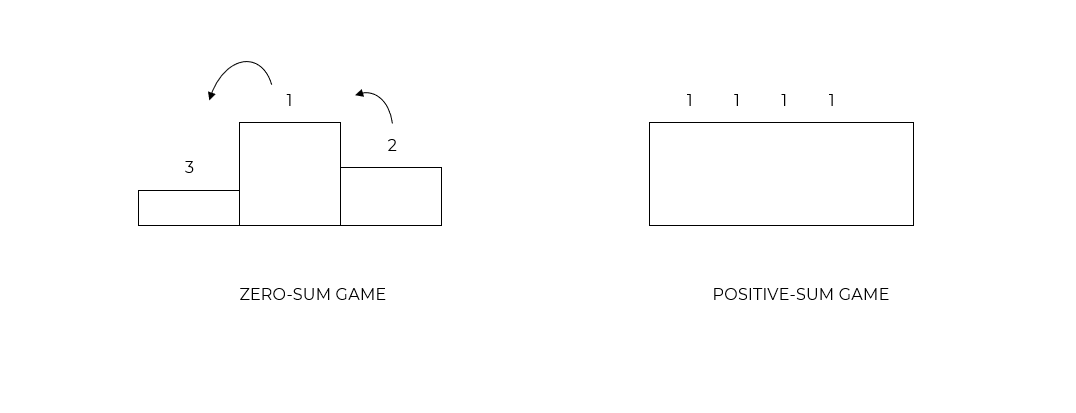
Understanding the difference between these two concepts—borrowed from Game Theory and economics—is the ultimate cheat code for leadership. It is the exact mechanism that explains why some teams are constantly bogged down in toxic office politics, while high-performing squads routinely manage to bend the rules of math and make 2 + 2 = 5.
Here is the theory behind the games we play, and how elite teams actively hack the rules to achieve impossible synergy.
The Theory: Slicing the Pie vs. Baking a Bigger One
The Zero-Sum Game (The Fixed Pie)
In game theory, a zero-sum game is a mathematical representation of a situation where one participant’s gain is exactly equal to another participant’s loss. The total net change in wealth or benefit is zero.
Think of poker. If I win $100, it means the other players at the table collectively lost exactly $100. The pie is fixed. The only way for me to get a bigger slice is to ensure you get a smaller one.
When humans apply a zero-sum mindset to the workplace, the results are disastrous. In a zero-sum company, employees believe there is a finite amount of status, credit, and money. Therefore, your success is a direct threat to me. This breeds a culture of information hoarding, backstabbing, and departmental silos. People spend 80% of their energy fighting over who gets the credit, and only 20% actually doing the work.
The Positive-Sum Game (The Expanding Pie)
A positive-sum game occurs when the total of gains and losses is greater than zero. No one has to lose for you to win. Instead of fighting over a fixed pie, the players work together to bake a much larger pie [1].
Trade is a classic positive-sum game. If I trade you my surplus apples for your surplus shoes, we are both fundamentally wealthier than we were a moment ago. Knowledge and collaboration are the ultimate positive-sum assets. If I give you a physical dollar, I no longer have it. But if I share a brilliant idea with you, I do not lose it. Now we both have the idea, and we can combine it to create a third, entirely new concept.
Changing the Rules of the Game
If you find yourself stuck in a toxic, zero-sum environment, there is good news. In their seminal book on game theory, The Art of Strategy, economists Avinash Dixit and Barry Nalebuff emphasize a crucial lesson: You do not have to accept the game as it is given to you [2].
If a corporate structure pits people against each other for a limited bonus pool, it is actively enforcing a zero-sum game. Elite leaders don’t just play the game better; they change the payoffs and the rules so that cooperation becomes the most rational, profitable choice for everyone involved.
How Great Teams Make 2 + 2 = 5
In mathematics, 2 + 2 is always 4. But in human dynamics, 2 + 2 can equal 3, or it can equal 5.
If you put two brilliant zero-sum players on a team, they will expend so much friction fighting for dominance that their combined output will be less than what they could achieve alone (2 + 2 = 3). High-performing teams achieve synergy (2 + 2 = 5) by intentionally designing their environment to be ruthlessly positive-sum. Here is how they do it:
1. They kill the “Credit Economy”
In average teams, credit is the currency. People will actively let a project fail if they feel they aren’t going to get the spotlight for it. High-performing teams realize that fighting over credit is a zero-sum trap.
Elite teams shift their focus entirely to the outcome. They understand a fundamental truth of business: When the pie gets big enough, everybody gets fed. If a startup builds a billion-dollar product, no one cares who came up with the specific idea for the UI design. The market rewards the whole team. By abandoning the fight for individual credit, they free up massive amounts of mental bandwidth to focus purely on execution.
2. They practice “Idea Sex”
When an average team brainstorms, it is a zero-sum battle of egos. If my idea is chosen, yours is rejected.
Positive-sum teams engage in what author Matt Ridley famously called “ideas having sex” [3]. They don’t view ideas as personal property to be defended; they view them as raw materials. When a team member proposes an idea, the rest of the team doesn’t try to shoot it down to elevate their own. They apply the “Yes, and...” principle. They combine distinct concepts, layering expertise from engineering, marketing, and design, until the final idea is exponentially more powerful than any single person could have conceived alone.
3. They leverage Comparative Advantage
In a zero-sum environment, people try to be good at everything to protect their status. They refuse to delegate out of fear of becoming irrelevant.
Positive-sum teams embrace the economic law of comparative advantage [4]. They actively look for what their teammates do better than them. If you are a world-class strategist but terrible at building slide decks, and your colleague is a master communicator but weak on strategy, a zero-sum player hides their weakness. A positive-sum player says, “I will do the thinking, you do the translating.”
By hyper-specializing and trusting the team to cover their blind spots, the collective output skyrockets.
The Takeaway: Choose Your Game
Naval Ravikant, a prolific investor and thinker on modern wealth creation, summarized this perfectly: “Play iterated games. All the returns in life, whether in wealth, relationships, or knowledge, come from compound interest.” [5]
Zero-sum games do not compound. They are finite, stressful, and ultimately lonely. You might win the promotion, but you will be surrounded by enemies you created along the way.
The greatest cheat code in business is realizing that you can choose which game you play. If you want to build high-performing teams, you have to relentlessly identify and eliminate zero-sum dynamics. Reward collaboration. Punish information hoarding. Celebrate collective victories.
When you convince a group of smart people to stop fighting over the slices and start baking a bigger pie, the math of the universe bends. That is when 2 + 2 finally equals 5.
Sources
[1] Wright, R. (2000). Nonzero: The Logic of Human Destiny. Pantheon Books. (Explores how human biological and cultural evolution is driven by the shift from zero-sum to positive-sum interactions).
[2] Dixit, A. K., & Nalebuff, B. J. (2008). The Art of Strategy: A Game Theorist’s Guide to Success in Business and Life. W. W. Norton & Company. (Demonstrates how to anticipate competitors’ moves and actively restructure the “rules of the game” to turn zero-sum conflicts into win-win scenarios).
[3] Ridley, M. (2010). The Rational Optimist: How Prosperity Evolves. HarperCollins. (Introduces the concept of “ideas having sex” to explain how human collaboration and trade create exponential innovation).
[4] Ricardo, D. (1817). On the Principles of Political Economy and Taxation. John Murray. (The foundational text introducing the economic theory of comparative advantage, demonstrating why collaboration yields higher outputs even when one party is more skilled overall).
[5] Jorgenson, E. (2020). The Almanack of Naval Ravikant: A Guide to Wealth and Happiness. Magrathea Publishing. (Compiling Naval Ravikant’s thoughts on compound interest in business, positive-sum wealth creation, and playing long-term iterated games).