


In the wake of compounding global disruptions—from pandemic shocks and geopolitical fractures to the violent acceleration of generative AI—business leaders clung to a comforting corporate myth: “We just have to survive the storm until we land in the New Normal.”
In his book, The Uncertainty Principle: Riding the Waves of the Never Normal, tech entrepreneur and visionary thinker Peter Hinssen shatters that illusion with an uncomfortable diagnosis [1].
The “New Normal” does not exist. It never will [1].
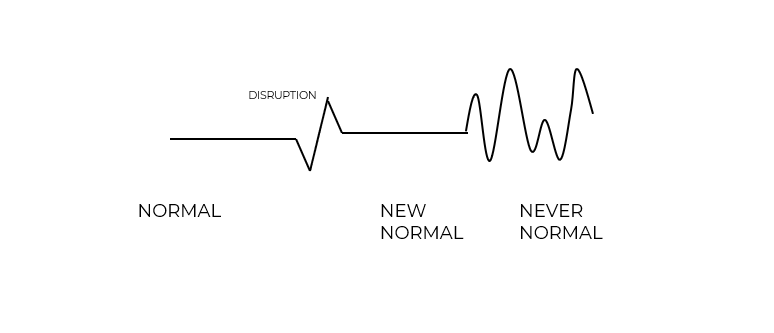
Most organizations are suffering from deep strategic paralysis because their leaders treat uncertainty as a temporary anomaly—a bug to be endured until baseline stability returns [1, 2].
When you treat stability as the goal, you design rigid, 150-year-old industrial pyramids: heavy layers of management, brittle five-year strategic roadmaps, and defensive risk protocols designed to shield the core. But when disruptions arrive not as isolated shocks, but as overlapping, exponential waves, those pyramids crack under the pressure [1].
High-performing organizations thrive in what Hinssen calls the Never Normal—a permanent state of continuous, non-linear volatility [1].
They do not try to build shock absorbers to resist the impact. They treat uncertainty not as a threat, but as their primary raw material for reinvention [1, 2].
The Four Pillars of the Uncertainty Principle
Hinssen demonstrates that enduring leaders and teams abandon the quest for equilibrium. Instead, they operate on four foundational operational principles designed to ride the waves of the Never Normal [1]:
[ 1. ANTICIPATION ]   ──→  Guarding the "Day After Tomorrow" (10% Rule)
         │
[ 2. OBELISK ORGS ]   ──→  Scaling with Intelligence, Not Headcount
         │
[ 3. DYNAMIC SENSING ] ──→  Replacing Static Plans with Hypothesis Sprints
         │
[ 4. ACTIVE HOPE ]    ──→  Radical Psychological Safety & Risk Appetite
1. Anticipation (Guarding the “Day After Tomorrow”)
Most corporate teams are consumed by the tyranny of the present. They burn 70% of their energy surviving Today (current operations) and 20% optimizing Tomorrow (incremental iterations) [1, 2].
Hinssen warns that without disciplined foresight, Today eats your future. High-performing teams fiercely protect the remaining 10% for the “Day After Tomorrow”—radical, paradigm-shifting ideas and exponential technologies that have zero short-term ROI today, but determine survival five years down the line [1, 2]. Anticipation is not about predicting the future; it is about building the intellectual muscle to recognize it faster than anyone else [1].
2. The Obelisk Architecture (Scaling with Intelligence, Not Headcount)
For over a century, organizations scaled linearly: more revenue required more layers of junior staff, creating a massive industrial pyramid [1].
In the Never Normal, high-performing teams evolve into “Obelisks”—slender, hyper-focused, cross-functional squads [1]. They do not scale by ballooning headcounts; they scale through human-machine symbiosis [1]. By embedding AI and automated intelligence directly into the core workflows, small teams achieve the operational leverage that once required entire business units, preserving speed, clarity, and decision-making agility [1].
3. Dynamic Sensing (Replacing 5-Year Roadmaps with Sprints)
In exponential environments, a static three-to-five-year plan is an elaborate suicide note [1, 2].
High-performing teams stop waiting for complete clarity before moving. They trade monolithic roadmaps for dynamic experimentation cycles:
Deploying minimum viable solutions into the field.
Sensing signals at the edges in real time.
Treating “cracks” in legacy systems not as dangerous failures to patch up, but as windows of opportunity to self-disrupt before a competitor does [1].
4. Active Hope & Risk Appetite (Failure as Discovery Data)
When volatility is constant, fear naturally drives organizations toward defensive conservation and micro-management [1, 3]. Hinssen argues that survival requires Active Hope—not passive optimism, but the deliberate courage to take bold, calculated bets in the dark [1].
High-performing teams decouple uncertainty from fear by establishing absolute psychological safety [1, 3]. In these teams, a failed experiment is not penalized as an execution error; it is rewarded as essential discovery data required to navigate ambiguity [1, 3].
The Lesson for High-Performing Teams
We are living through an era of profound transition: leaders are exhausted, markets are non-linear, and technology is moving faster than human biology can naturally process [1].
Managers think their job is to restore predictability and insulate their teams from the noise.
In reality, they are building fragile, reactive bunkers that will be swept away by the next wave [1].
If you run your team like a traditional pyramid:
You wait for complete data before acting, paralyzing your velocity.
You burn 100% of your talent on quarterly fires, abandoning the Day After Tomorrow.
You treat friction and disruption as existential threats.
If you navigate your team using the Uncertainty Principle:
You view ambiguity as an infinite supply of creative fuel.
You augment human intuition with machine intelligence to stay radically lean.
You stop longing for the calm waters of the past, and teach your team how to surf the Never Normal [1].
Bunkers crumble under pressure. Surfers ride the wave.
References & Supporting Sources
[1] Hinssen, Peter (2024). The Uncertainty Principle: Riding the Waves of the Never Normal. London: Mach Media / Nexxworks.
(The core text diagnosing the death of the “New Normal” and establishing the operational blueprint—spanning foresight, Obelisk organizational design, and intelligence scaling—for surviving perpetual volatility.)
[2] Hinssen, Peter (2017). The Day After Tomorrow: How to Survive in Times of Radical Innovation. London: Lannoo Campus.
(Introduces Hinssen’s foundational 70/20/10 strategic time-allocation model, demonstrating why organizations must structurally defend resources for horizon-three reinvention before current business models decay.)
[3] Edmondson, Amy C. (2018). The Fearless Organization: Creating Psychological Safety in the Workplace for Learning, Innovation, and Growth. Hoboken, NJ: John Wiley & Sons.
(Provides the clinical research underscoring Hinssen’s principle of risk appetite, demonstrating that teams cannot experiment or process failure as learning data in volatile environments without total psychological safety.)