


When we study wildly successful teams—whether it’s a startup that reached a billion-dollar valuation or a sports team that won consecutive championships—we love a good narrative. We praise their flawless strategy, their relentless grit, and their unique synergy.
But there is a silent, invisible co-founder in every great success story that we rarely like to acknowledge: Sheer luck.
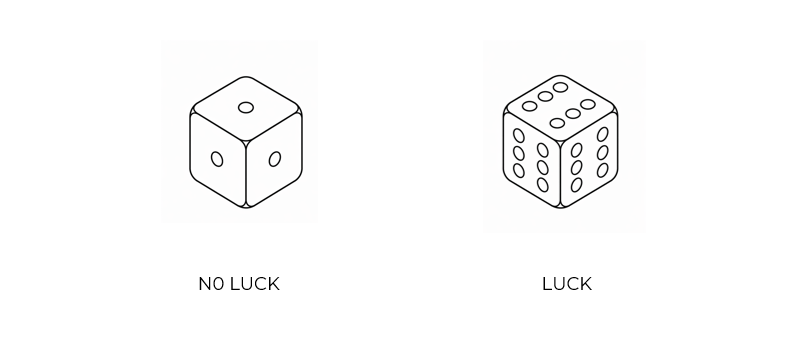
It is uncomfortable to admit that a team’s monumental success might just be a roll of the cosmic dice. But how much of greatness is actually engineered, and how much of it is just stumbling into the right place at the right time?
Let’s look at what the science of randomness, philosophy, and behavioral psychology say about the role of luck in great teams—and how you can actually train your team to become “luckier.”
The Uncomfortable Truth: Fooled by Randomness
If you want to deflate the ego of a highly successful team, hand them a copy of Nassim Nicholas Taleb’s Fooled by Randomness [1].
Taleb points out a massive blind spot in how we evaluate success: Survivorship Bias. When we look at a market-dominating team, we assume their specific habits and strategies caused their success. What we don’t see are the graveyard of a hundred other teams that had the exact same skills, the exact same work ethic, and the exact same strategy—but failed because they didn’t get a lucky break.
According to Taleb, we drastically underestimate the role of pure chance. The market is highly random, and sometimes, a team’s success is just the equivalent of winning the lottery.
Does this mean strategy is useless? Not at all. But it means that relying purely on strategy while ignoring the mechanics of luck is a fool’s errand. The question isn’t whether luck exists; the question is how a team interacts with it.
The 4 Types of Luck
Long before Taleb’s warnings, a neurologist named Dr. James H. Austin wrote a seminal book in 1978 called Chase, Chance, and Creativity [2]. He proposed that luck isn’t just one thing. There are four distinct types of luck.
Recently, entrepreneur and philosopher Naval Ravikant popularized this framework [3], showing how individuals and teams can move from passive recipients of luck to active creators of it.
Type 1: Blind Luck
This is pure cosmic chance. It’s where you happen to launch a remote-work software tool two months before a global pandemic forces everyone to work from home. You didn’t plan it. It just happened. Teams cannot rely on Type 1 luck.
Type 2: Hustle Luck
This luck is generated by motion. When a team operates with high energy, ships products rapidly, networks aggressively, and tests dozens of prototypes, they stir up the universe. As Naval points out, this is the luck of “running around creating a lot of energy and doing a lot of things” [3]. You stumble into a lucky break simply because you are covering a massive amount of surface area.
Type 3: Prepared Luck
Louis Pasteur famously said, “Chance favors the prepared mind.” Type 3 luck happens when a team possesses such deep expertise that they can spot a lucky anomaly that others would ignore.
When a team at 3M accidentally created an incredibly weak adhesive, most people would have thrown it away as a failure. But because of their “prepared luck,” they realized its potential. That “failure” became the Post-it Note.
Type 4: Engineered Luck
This is the ultimate tier of team performance. Type 4 luck happens when your team’s reputation, brand, and unique skill set become so well-known that luck seeks you out.
If your team becomes the undisputed best in the world at designing AI user interfaces, you don’t have to look for the next lucky break. Founders, investors, and brilliant engineers will bring lucky opportunities directly to your doorstep. You have engineered an environment where luck is magnetized to you.
Engineering the Magnet: Price Pritchett and the Quantum Leap
So, how does a team move from relying on Blind Luck (Type 1) to generating Hustle and Engineered Luck (Types 2 and 4)?
According to organizational expert Price Pritchett, author of You², luck isn’t just something that happens to you; it is a resource that is attracted to high levels of energy and ambition [4].
Pritchett argues that when teams pursue safe, incremental goals (like trying to improve sales by 5%), they don’t generate enough energy to attract serendipity. But when a team commits to a massive, seemingly impossible goal—a “Quantum Leap”—something fascinating happens.
The sheer audacity of a massive goal forces the team out of their routine. They have to break the rules, ask wild questions, and reach out to unlikely partners. This high-energy state acts as a magnet. As Pritchett notes, when you commit to a massive leap, you suddenly start noticing “lucky” coincidences, unexpected resources, and serendipitous connections [4].
You aren’t magically changing the universe; you are simply forcing your team to operate in the frequency of Type 2 (Hustle) and Type 3 (Prepared) luck.
The Takeaway for Leaders
If you lead a team, you must accept Taleb’s premise: the world is wildly random, and you cannot control Type 1 blind luck [1]. A competitor might get a lucky break. A macroeconomic shift might hurt your quarter.
But great teams don’t cry over bad luck, nor do they wait for good luck. They engineer it.
They increase their Hustle Luck by experimenting faster.
They increase their Prepared Luck by reading, learning, and staying curious about anomalies.
They increase their Engineered Luck by building an undeniable reputation.
And they set massive goals that generate the energy required to attract serendipity [4].
Luck isn’t magic. It’s a surface area. And the greatest teams are the ones that relentlessly expand it.
Sources & References
[1] Taleb, N. N. (2001). Fooled by Randomness: The Hidden Role of Chance in Life and in the Markets. Texere. (Explores survivorship bias and how we mistake random luck for skill).
[2] Austin, J. H. (1978). Chase, Chance, and Creativity: The Lucky Art of Novelty. Columbia University Press. (The original framework of the four types of luck in scientific discovery and creativity).
[3] Jorgenson, E. (2020). The Almanack of Naval Ravikant: A Guide to Wealth and Happiness. Magrathea Publishing. (Naval’s synthesis and popularization of Austin’s four types of luck as applied to modern business and wealth creation).
[4] Pritchett, P. (1994). You²: A High Velocity Formula for Multiplying Your Personal Effectiveness in Quantum Leaps. Pritchett & Associates. (Discusses how radical goals create energy that attracts unexpected, “lucky” opportunities and resources).