


In 2012, veteran hostage negotiator and IMD professor George Kohlrieser published Care to Dare, formalizing one of modern management’s most influential ideas: Secure Base Leadership [1].
Borrowing from attachment theory, Kohlrieser demonstrated that human beings cannot unleash their full potential, take existential risks, or innovate without a “secure base” [1]. To unlock peak performance, leaders must master two levers:
Care: Providing psychological safety, deep listening, protection, and unconditional trust [1].
Dare: Raising the bar, challenging assumptions, expecting excellence, and pushing people into the unknown [1].
In corporate boardrooms and HR departments, this concept was quickly codified into a comfortable, sequential dogma: Care must come first. First, you build trust and comfort; only then do you dare to challenge.
The result in many organizations has been the Corporate Country Club: an environment overflowing with polite consensus, safe feedback, and accommodated feelings. It feels secure, but execution stalls, standards decay, and top performers quietly depart.
At the other extreme sits the Toxic Grindhouse: an environment of pure, weaponized “Dare” without safety, creating burnout, political self-preservation, and high attrition.
We are left with a fundamental chicken-and-egg dilemma: Does Care create the Dare, or does the Dare forge the Care?
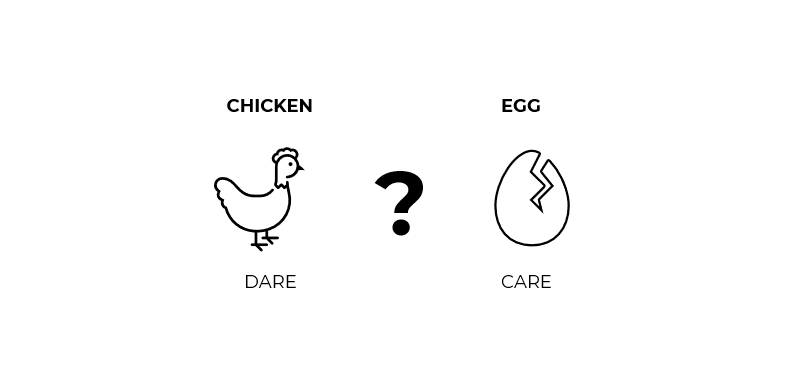
When you examine world-class, dynasty teams across history—from Vince Lombardi’s Green Bay Packers [2] and Navy SEAL units [3] to Pixar’s Braintrust [4] and Jensen Huang’s Nvidia—you find that elite operators answer the question very differently than standard corporate playbooks.
In the Arena: The “Dare First” Reality
Look beneath the surface of the world’s most relentless teams, and you discover that trust is not handed out as an upfront entitlement. It is an emergent property earned through the crucible of extreme standards:
Vince Lombardi’s Green Bay Packers: Lombardi drove his players through relentless, unforgiving drills, famous for declaring: “Perfection is not attainable, but if we chase perfection we can catch excellence” [2]. He didn’t start with hugs; he tested his players’ limits. Yet Hall of Famer Jerry Kramer noted that the players would run through walls for Lombardi because his fierce demands were matched by profound, lifelong commitment to their character and welfare [2]. The high bar wasn’t cruelty; it was the ultimate expression of respect.
Navy SEALs (BUD/S & Teams): The training pipeline (BUD/S) is 100% “Dare”—a brutal filter designed to test who folds under pressure [3]. The entrance fee to the community is demonstrated competence and grit. Once in a platoon, however, the dynamic transforms into the ultimate “Secure Base.” In the After Action Review (AAR), ranks are removed at the door [3]. An enlisted operator can bluntly challenge an officer’s tactical decision without fear of reprisal. The ruthless standard creates the trust; the trust enables radical truth [3].
Jensen Huang at Nvidia: Jensen is famous for publicly grilling teams, stress-testing engineering logic from first principles in rooms of fifty peers. But Nvidia pairs this merciless standard with deep institutional loyalty: Huang rarely fires people for honest, hard-fought failures. Instead, the problem is tortured until the team masters it, and equity is distributed broadly. The standard is terrifyingly high, but the collective safety net is absolute.
Pixar’s Braintrust: Ed Catmull structured Pixar’s creative engine around unvarnished peer critiques [4]. The feedback on draft cuts is direct and painful. But Catmull established an unshakeable boundary: the critique targets the project, never the person, and the director retains full creative control [4].
These environments don’t start with soft reassurances. They set an uncomfortably high bar, filter for commitment, and forge brotherhood in the shared struggle.
The Scientific Reconciliation: Standards Meet Safety
Does this mean George Kohlrieser’s model is wrong? Not at all. It means traditional corporate HR misunderstood the mechanics of his insight [1].
The scientific framework that resolves the “Chicken or Egg” debate comes from Harvard Business School professor Amy Edmondson [5].
Edmondson pioneered the research on psychological safety, but her findings are routinely misunderstood [5]. Psychological safety is not “softness,” “politeness,” or “comfort.” It is the shared conviction that the team is safe for interpersonal risk-taking—admitting errors, challenging the consensus, and speaking brutal truths [5].
Edmondson mapped organizational performance across two critical vectors: Psychological Safety (Care) and Accountability / Standards (Dare) [5]:
                                     HIGH STANDARDS / DARE
                                                │
                           ANXIETY ZONE         │     HIGH-PERFORMANCE ZONE
                       (Fear, Burnout, Politics)│   (Elite Teams, Radical Truth)
                                                │
  LOW SAFETY / CARE ────────────────────────────┼──────────────────────────── HIGH SAFETY / CARE
                                                │
                            APATHY ZONE         │       COMFORT ZONE
                      (Disengagement, Neglect)  │   (Politeness, Mediocrity)
                                                │
                                     LOW STANDARDS / DARE
Low Safety + Low Standards = The Apathy Zone: Disengagement and passive compliance.
High Safety + Low Standards = The Comfort Zone: High politeness, low accountability, zero urgency.
Low Safety + High Standards = The Anxiety Zone: People fear failure, hide bad news, play zero-sum status games, and burn out [5].
High Safety + High Standards = The High-Performance Zone: The domain where Kohlrieser’s Secure Base truly operates [1, 5].
When Google spent years analyzing hundreds of engineering teams in Project Aristotle, searching for the algorithm of elite performance, they expected to find the perfect mix of IQs or technical backgrounds [6].
Instead, they discovered that psychological safety was the foundational prerequisite [6]. But safety alone wasn’t enough; it was the launchpad that allowed high-performing engineers to hold one another to relentless standards of execution without collapsing into defensiveness [5, 6].
The Three Operational Pillars of Elite Teams
Synthesizing the work of Kohlrieser [1], Edmondson [5], Richard Hackman [7], and Daniel Coyle [8], high performance is engineered through three specific mechanics:
[ 1. The Crucible ]   ──→  The Standard as the Filter (Dare)
         │
[ 2. The Forum    ]   ──→  Ego-Free Candor & Decoupled Status (Truth)
         │
[ 3. The Covenant ]   ──→  Radical Belonging & Mutual Protection (Care)
1. The Crucible: Standards as the Filter (Dare)
Championship teams do not lower the bar to make people comfortable; they use the bar to build trust [7, 8].
True psychological safety cannot exist alongside unaddressed incompetence. If an operator suspects the person next to them will fold under pressure, fear enters the system [3].
The “Dare” is the proof point: everyone in the room has demonstrated their commitment to the craft [1, 7].
2. The Forum: Candor Decoupled from Status (Truth)
In a low-performing culture, challenging an idea means challenging someone’s corporate rank [5].
In elite teams, the idea is aggressively divorced from the person [4]. In a SEAL debrief or a Pixar Braintrust, the inquiry is never “Who is right?” but “What is the ground truth?” [3, 4].
Psychological safety is precisely what enables fierce, direct debate without damaging relationships [1, 5].
3. The Covenant: Radical Belonging and Protection (Care)
Dare without Care is merely an extractive sweatshop that inevitably self-destructs.
High-performing cultures transmit constant, unmistakable belonging cues: “We have terrifyingly high expectations, but we will not abandon you while you climb” [8].
The leader’s role is to act as the ultimate secure base—absorbing political noise, protecting the team from bureaucracy, and standing in front of them when strategic bets fail [1, 7].
The Answer to the Paradox
So, which comes first? The Chicken or the Egg? Trust or Dare?
The answer is that they are a closed feedback loop, but the sequence matters:
The Dare sets the perimeter: Leaders establish the uncompromising standard of the mountain to be climbed.
Competence builds the Trust: Facing the challenge together proves that everyone can carry their weight.
The Care seals the bond: Shared struggle under high expectations creates a secure base of mutual respect and psychological safety that allows the team to dare even greater feats [1, 8].
Do not build a country club and wonder why execution lags. Do not run a sweatshop and wonder why your best talent walks away.
Set an uncomfortably high bar. Guard it relentlessly. But ensure every person on your team knows that as long as they are fighting for the mission, you will back them through the fire.
References & Supporting Sources
Kohlrieser, George, Goldsworthy, Susan, & Coombe, Duncan (2012). Care to Dare: Unleashing Astonishing Potential Through Secure Base Leadership. San Francisco: Jossey-Bass.
(The foundational text conceptualizing the ‘Care to Dare’ framework, demonstrating how leaders function as secure bases by combining high interpersonal care with audacious challenge.)Maraniss, David (1999). When Pride Still Mattered: A Life of Vince Lombardi. New York: Simon & Schuster.
(The definitive biography detailing how Lombardi integrated brutal tactical expectations with profound personal devotion, loyalty, and character-building for his players.)Willink, Jocko & Babin, Leif (2015). Extreme Ownership: How U.S. Navy SEALs Lead and Win. New York: St. Martin’s Press.
(Details the mechanics of elite military teams: uncompromising entry standards, decentralized command, and blameless After Action Reviews where rank is stripped away to pursue objective truth.)Catmull, Ed & Wallace, Amy (2014). Creativity, Inc.: Overcoming the Unseen Forces That Stand in the Way of True Inspiration. New York: Random House.
(Explains the mechanics of Pixar’s “Braintrust”—institutionalizing candid creative critique by decoupling project evaluation from personal ego and corporate status.)Edmondson, Amy C. (2018). The Fearless Organization: Creating Psychological Safety in the Workplace for Learning, Innovation, and Growth. Hoboken, NJ: John Wiley & Sons.
(Pioneered the 2x2 matrix of Psychological Safety vs. Performance Standards, empirically demonstrating that high performance requires maximizing both psychological safety and uncompromising accountability.)Duhigg, Charles (2016). “What Google Learned From Its Quest to Build the Perfect Team.” The New York Times Magazine; and Rozovsky, Julia (2015), “The Five Keys to a Successful Google Team.” Google re:Work.
(The landmark Project Aristotle study showing that team norms—led by psychological safety—far outweigh team composition in driving execution.)Hackman, J. Richard (2002). Leading Teams: Setting the Stage for Great Performances. Boston: Harvard Business School Press.
(Outlines the essential structural conditions—clear boundaries, compelling direction, enabling context—required for teams to sustain self-correcting excellence.)Coyle, Daniel (2018). The Culture Code: The Secrets of Highly Successful Groups. New York: Bantam Books.
(Investigates elite groups—from SEAL Team Six and the San Antonio Spurs to IDEO—identifying the neurological signals of belonging cues, shared vulnerability, and clear purpose.)